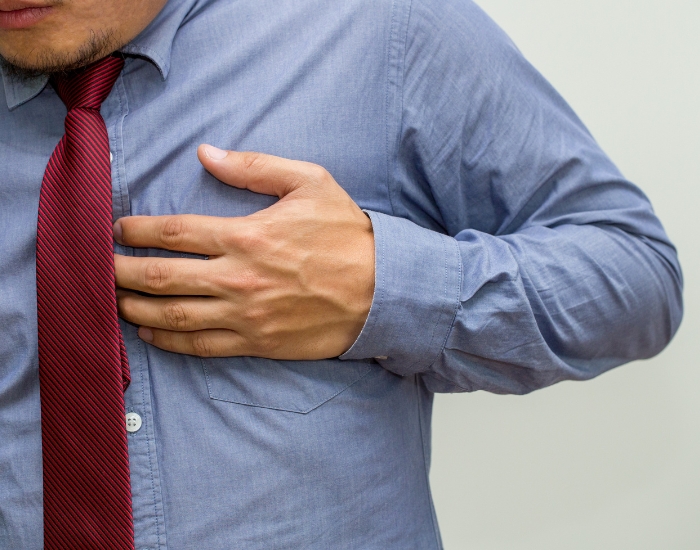
What doctor should you see for chest pain? It depends on what is happening now. New, severe, crushing or spreading chest pain needs 911, not an appointment. Chest pain that has passed, comes and goes, or shows up with exertion should be checked within days by your primary care doctor or a cardiologist, the specialist who diagnoses and treats heart-related chest pain.

Medically reviewed by
Board-certified cardiologist · Katy & Sugar Land, TX
Fellowship-trained in cardiovascular disease, interventional cardiology, echocardiography and advanced heart failure and transplant cardiology. Former Assistant Professor of Cardiology at McGovern Medical School.
Which doctor treats chest pain?
Chest pain is one of the most common reasons adults seek care, and several kinds of doctors can be involved. The right first stop depends less on the pain itself and more on how it started, how long it lasts and what comes with it.
| Your situation | Where to go first |
|---|---|
| Sudden, severe, crushing or pressure-like pain, especially with sweating, nausea, shortness of breath or pain spreading to the arm, jaw or back | Call 911 (emergency department) |
| Chest pain that came and went and you now feel well | Same-week visit with your primary care doctor or a cardiologist |
| Chest tightness or pressure that appears with walking, stairs or stress and eases with rest | Cardiologist; this pattern can be angina |
| Burning pain after meals or when lying down, with sour taste | Primary care or a gastroenterologist, after heart causes are considered |
| Sharp pain that worsens with a deep breath or cough, with fever or recent illness | Primary care or urgent care; ER if breathing is difficult |
| Pain you can reproduce by pressing on the chest wall, after lifting or exercise | Primary care or a sports medicine/orthopedic clinician |
When there is any doubt about whether the heart is involved, the safest choice is to have the heart checked first. A normal heart evaluation then lets other doctors focus on digestive, lung or muscle causes with confidence.
When is chest pain an emergency?
A heart attack happens when blood flow to part of the heart muscle is blocked. According to the National Heart, Lung, and Blood Institute, the most common symptom is chest pain or discomfort that lasts more than a few minutes, or goes away and comes back. It may feel like pressure, squeezing, fullness or pain.
Do not drive yourself to the hospital and do not wait to see whether the pain passes. Emergency crews can start an EKG and treatment on the way, and every minute of restored blood flow protects heart muscle. Our article Should I go to the ER for chest pain? walks through this decision in more detail.
- Pressure, squeezing or fullness lasting more than a few minutes, or that goes away and returns
- Pain spreading to one or both arms, the jaw, neck, back or stomach
- Shortness of breath, cold sweat, nausea or lightheadedness
- Fainting, a very fast or irregular heartbeat, or sudden severe tearing pain in the chest or back
Follow the 911 dispatcher’s instructions, including any advice about aspirin.
Should you see a cardiologist or a primary care doctor?
Both are reasonable starting points for chest pain that is not an emergency. Your primary care doctor knows your history, can examine you, check an EKG and order basic blood work. Many patients are then referred to a cardiologist for a fuller heart evaluation.
You can usually go straight to a cardiologist when:
- Chest discomfort is triggered by exertion, cold air, heavy meals or emotional stress and fades with rest.
- You already have heart disease, a stent, bypass surgery, heart failure or a heart rhythm problem.
- You have strong risk factors: high blood pressure, diabetes, high cholesterol, smoking, kidney disease or a parent or sibling with early heart disease.
- You were recently in the ER for chest pain and were told to follow up with cardiology.
- An EKG was abnormal or a stress test was abnormal.
Most insurance plans let you see a specialist directly, while some HMO plans require a referral. Our team can help you check what your plan needs.
Signs your chest pain needs a heart specialist
Heart-related chest pain does not always feel dramatic. Cardiologists pay close attention to these patterns:
- Predictable pain with effort. Pressure that comes on at the same level of activity is the classic sign of stable angina, caused by narrowed coronary arteries.
- Pain with breathlessness or fatigue. Especially in women, people with diabetes and older adults, heart symptoms may show up as unusual tiredness or shortness of breath rather than sharp pain.
- Pain with palpitations, dizziness or fainting. These can point to a rhythm problem that needs monitoring.
- Changing pattern. Angina that occurs more often, with less effort or at rest needs same-day medical attention.
Learn more about the broader signs and symptoms of heart disease.
What happens at a cardiology visit for chest pain?
A chest pain evaluation starts with a careful conversation: when the pain began, what it feels like, what triggers or relieves it, and your personal and family history. After a physical exam, testing is chosen to answer specific questions rather than ordered by routine.
- Electrocardiogram (EKG) in the office to look for rhythm problems, strain or signs of a prior heart attack.
- Echocardiogram in the office to see heart muscle strength, valves and the lining around the heart.
- Stress testing, such as an exercise stress test, stress echo or nuclear imaging, to see how the heart handles exertion.
- Rhythm monitoring with a Holter or event monitor if symptoms come with palpitations.
- Blood tests for cholesterol, blood sugar, kidney function and other risk markers.
- Coronary imaging, such as a coronary calcium scan or CT angiography, which we coordinate with imaging partners when needed.
If testing suggests a significant blockage, Dr. Khalid may recommend cardiac catheterization, which is performed at an affiliated hospital. Read more about our chest pain evaluation and treatment in Katy and Sugar Land.
Other specialists for chest pain that is not from the heart
Many chest pain evaluations end with good news: the heart is healthy. The cause may then belong to another specialist:
- Gastroenterologist: acid reflux (GERD), esophageal spasm, ulcers or gallbladder problems. See can acid reflux feel like chest pain? and chest pain after eating.
- Pulmonologist: asthma, pneumonia, pleurisy or other lung conditions.
- Primary care, sports medicine or physical therapy: strained chest muscles or costochondritis, an inflammation of the cartilage where ribs meet the breastbone.
- Mental health professional: panic attacks can cause real chest pain, racing heartbeat and breathlessness, but they should be diagnosed only after heart causes are ruled out.
How to prepare for a chest pain appointment
A little preparation helps your cardiologist reach answers faster:
- Write down when the pain happens, how long it lasts, what it feels like and what makes it better or worse.
- Bring a list of all medicines and supplements, including doses.
- Bring records from any ER visit, EKG, stress test or lab work, or let our office request them.
- Note family history of heart attack, sudden death or high cholesterol, and the age it happened.
- Wear comfortable shoes and clothing in case a stress test is scheduled.
Chest pain evaluation in Katy and Sugar Land
Advanced Cardiology sees adults with chest pain at two offices in Fort Bend and west Harris County. Dr. Adnan Khalid reviews your symptoms, EKG and test results himself, and EKG and echocardiogram testing are available in the office so many questions can be answered at the first visit.
Katy office: 410 W Grand Pkwy S, Suite 4D, Katy, TX 77494
Sugar Land office: 7102 Tarrington Ave, Suite 505, Sugar Land, TX 77479
Phone: (713) 258-6111
We also see patients from Fulshear, Richmond, Rosenberg, Stafford, Missouri City and west Houston.
Get chest pain checked by a cardiologist
If your chest pain has passed but you are still worried, or it keeps coming back, request a visit with Dr. Khalid in Katy or Sugar Land.
Having symptoms right now? Call 911. Do not wait for an appointment.
Frequently asked questions
What kind of doctor should I see for chest pain?
For chest pain that is not an emergency, start with your primary care doctor or a cardiologist. A cardiologist is the specialist for chest pain that may come from the heart, especially pain with exertion or in people with heart risk factors. Severe or ongoing chest pain needs 911.
Can I see a cardiologist without a referral?
Many insurance plans allow you to schedule directly with a cardiologist. Some HMO plans require a referral from a primary care doctor first. Our office can help you check your plan’s rules before your visit.
Should I go to urgent care for chest pain?
Urgent care is not the right place for possible heart attack symptoms because it may not have the testing and treatment a heart attack needs. For severe, new or ongoing chest pain, call 911. Urgent care can be reasonable for clearly mild, muscle-related pain.
How do I know if chest pain is heart-related?
You cannot reliably tell at home. Pain that feels like pressure or squeezing, comes with exertion, spreads to the arm, jaw or back, or appears with shortness of breath, sweating or nausea is more concerning. An EKG, blood tests and sometimes stress testing are needed to know for sure.
What tests will a cardiologist order for chest pain?
Common tests include an EKG, an echocardiogram, blood tests and a stress test. Some patients also need a heart monitor, coronary calcium scan, CT angiography or cardiac catheterization. Tests are chosen based on your symptoms and risk.
Can a cardiologist find the cause if my EKG was normal?
Yes. A resting EKG can be normal between episodes even when coronary artery disease is present. Stress testing and imaging show how the heart works under strain and often reveal problems a resting EKG misses.
How soon should I see a doctor for chest pain that went away?
Arrange a visit within a few days, sooner if you have heart risk factors. If the pain returns, lasts more than a few minutes or comes with other warning signs, call 911 instead of waiting.
Trusted health resources
- Heart Attack: Symptoms, National Heart, Lung, and Blood Institute (NIH)
- Chest Pain, MedlinePlus, U.S. National Library of Medicine
- Stable angina, MedlinePlus Medical Encyclopedia
- Coronary Heart Disease: Symptoms, National Heart, Lung, and Blood Institute (NIH)
- Costochondritis, MedlinePlus Medical Encyclopedia
Medical disclaimer: This article is for general education and is not a diagnosis or a substitute for care from your own doctor. If you think you may be having a heart attack, stroke or another emergency, call 911 right away.