
Abnormal Stress Test Evaluation
Abnormal Stress Test Cardiologist in Katy & Sugar Land, TX
An abnormal or “positive” stress test means the heart did not respond to exertion the way it should, and the most common reason is that one or more coronary arteries may be narrowed. It is not a diagnosis by itself. Stress tests produce false positives, particularly in women and in people with baseline EKG changes, and the next step depends on how abnormal the result was, what you felt during the test, and your overall risk. At Advanced Cardiology, Adnan Khalid, MD reviews abnormal stress test results and determines whether further imaging, a catheterization, or medical treatment is the right path.
Patients are seen in Katy and Sugar Land, and visits after an abnormal result are prioritized.
Board-Certified Cardiologist • Katy & Sugar Land • New Patients Welcome
Important Safety Information
Symptoms After an Abnormal Stress Test That Need Emergency Care
If you have had an abnormal stress test and now have chest pain or pressure at rest, chest discomfort lasting more than a few minutes, pain spreading to the arm, jaw, neck, or back, shortness of breath, sweating, nausea, or fainting, call 911. Those symptoms in someone with a positive stress test may represent a heart attack. This page is for patients whose result was abnormal but who are currently stable and want to understand what happens next.
Understanding Your Result
What Does an Abnormal Stress Test Mean?
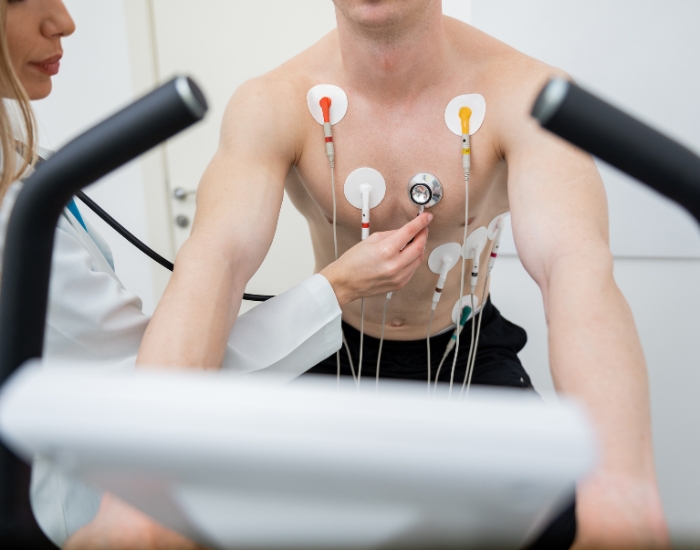
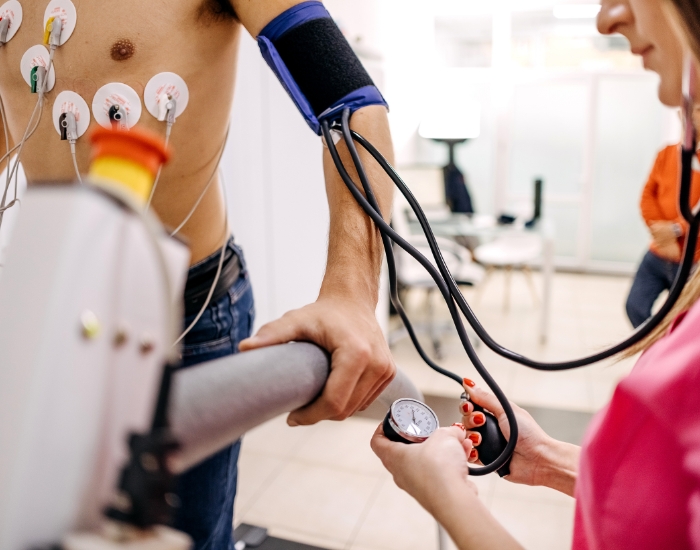
A stress test looks at how the heart performs when it has to work harder, either on a treadmill or with a medication that mimics exercise. Depending on the type, it tracks the EKG, blood pressure, and symptoms during exertion (exercise stress test), adds ultrasound images of the heart's motion (stress echocardiogram), or uses a small amount of radioactive tracer to map blood flow to the heart muscle (nuclear stress test).
The test is called abnormal, or positive, when something changes under stress that should not: the EKG develops ST-segment shifts, a section of heart wall stops moving normally on ultrasound, the nuclear images show an area receiving less blood, blood pressure falls instead of rising, or you develop chest pain or an arrhythmia. Each of these can indicate that a coronary artery is narrowed enough to limit blood flow when demand rises.
The key word is “can.” Stress tests are screening tools with a meaningful false-positive rate, and results are graded. A mildly abnormal EKG change in a low-risk patient with no symptoms means something very different from a large blood-flow defect in a patient with chest pain. Interpreting the result in context is the cardiologist's job.
When to Seek Evaluation
When Should You See a Cardiologist After an Abnormal Stress Test?
Every abnormal stress test should be reviewed by a cardiologist, and sooner rather than later. How quickly depends on the details. A visit within days is appropriate when:
- The test was stopped early because of chest pain, a drop in blood pressure, or an arrhythmia
- The report describes a large or multiple blood-flow defects, or a low ejection fraction under stress
- You have chest pressure, tightness, or breathlessness with everyday activity
- You have diabetes, known coronary disease, a prior heart attack, or a prior stent or bypass
- You have several risk factors: high blood pressure, high cholesterol, smoking, or a family history of early heart disease
A routine visit is reasonable when the abnormality was mild, you had no symptoms, and the test was ordered as a screening or pre-operative check. Either way, do not assume a mildly abnormal result can be ignored, and do not start or stop medications on your own while waiting to be seen.
Common Findings
Common Abnormal Stress Test Findings
Stress test reports use a shared vocabulary. These are the terms that most often bring patients to the office.
ST-Segment Changes
Shifts in the EKG's ST segment during exercise are the classic sign of reduced blood flow, though they are less specific in women and in patients with baseline EKG abnormalities.
Reversible Perfusion Defect
On a nuclear test, an area that takes up less tracer with stress than at rest suggests a narrowed artery supplying that region. A defect present both at rest and stress may reflect an old heart attack.
Wall Motion Abnormality
On a stress echo, a section of heart wall that moves normally at rest but weakens under stress points to a blood-flow problem in that territory.
Chest Pain During the Test
Chest discomfort that appears with exertion and resolves with rest is angina, and it carries weight even when the EKG and images are only mildly abnormal.
Blood Pressure Drop
Blood pressure that fails to rise or drops during exercise is a concerning sign that can indicate extensive disease or a weakened heart muscle.
Poor Exercise Capacity
Stopping in the first few minutes, or an inability to reach the target heart rate, limits what the test can say and sometimes means a different test is needed.

Meet Your Cardiologist
Evaluation With Adnan Khalid, MD
Adnan Khalid, MD is a board-certified cardiologist with fellowship training in cardiovascular disease, interventional cardiology, and advanced heart failure and transplant cardiology. Interventional training is particularly relevant after an abnormal stress test, because the central question is whether the coronary arteries need to be looked at directly, and if so, whether a blockage should be treated with medication, a stent, or bypass surgery.
Dr. Khalid reviews the stress test images and tracings himself, weighs the findings against your symptoms and risk profile, and decides whether the result should be confirmed with another non-invasive test or evaluated with cardiac catheterization. When catheterization is appropriate, it is coordinated at an appropriate hospital facility, and he continues to manage your care afterward.
Possible Causes
What Can Cause an Abnormal Stress Test?
Coronary artery disease is the cause everyone worries about, and it is the most important one, but it is not the only explanation.
Coronary Artery Disease
Plaque narrowing one or more coronary arteries limits blood flow when the heart works harder. This is the finding a stress test is designed to detect, and the more pronounced the abnormality, the more likely a significant narrowing is present. Learn more about cardiovascular disease.
Small-Vessel and Spasm-Related Causes
Some patients, women in particular, have reduced blood flow from disease in the heart's smallest vessels or from artery spasm rather than a fixed blockage. These can produce an abnormal test with arteries that look open on catheterization, and they are treated differently.
Heart Muscle and Valve Conditions
A thickened heart muscle from long-standing high blood pressure, a weakened heart from cardiomyopathy, or a narrowed aortic valve can all cause the heart to respond abnormally to exertion without any coronary blockage.
False Positives
Baseline EKG abnormalities, certain medications such as digoxin, electrolyte shifts, breast tissue or diaphragm attenuation on nuclear images, poor exercise effort, and rapid breathing can all produce an abnormal-appearing result in a healthy heart. This is why a positive stress test is confirmed before anyone proceeds to catheterization.
Your Evaluation
How a Cardiologist Evaluates an Abnormal Stress Test
The first task is to estimate how likely it is that the abnormal result reflects real coronary disease. That estimate combines the test itself with everything known about you.
Reviewing the Test
Dr. Khalid reviews the actual EKG tracings, images, and report: how far into the test the changes appeared, how large the affected area was, whether the heart's pumping function fell under stress, and whether you had symptoms. A test that turned abnormal at high workload with a small defect is a different situation from one that turned abnormal early with a large one.
Symptoms and Risk Factors
Chest discomfort with activity, breathlessness, and reduced exercise tolerance raise the likelihood that the finding is real. So do age, diabetes, high blood pressure, high cholesterol, smoking, kidney disease, and a family history of early heart disease. Prior EKGs, echocardiograms, or calcium scores are reviewed if available.
Examination and Baseline Testing
The exam includes blood pressure, heart and lung sounds, and pulses. A resting EKG is obtained, and cholesterol, glucose, and kidney function may be checked if not already on file.
Choosing the Next Step
The result of this assessment is one of three paths: reassurance with risk-factor management for a probable false positive, a confirmatory non-invasive test when the picture is unclear, or direct evaluation of the arteries when the probability of significant disease is high.
Cardiac Testing
Cardiac Testing That May Be Recommended
After an abnormal stress test, further testing is chosen to either confirm the finding non-invasively or to look at the arteries directly.
Echocardiogram
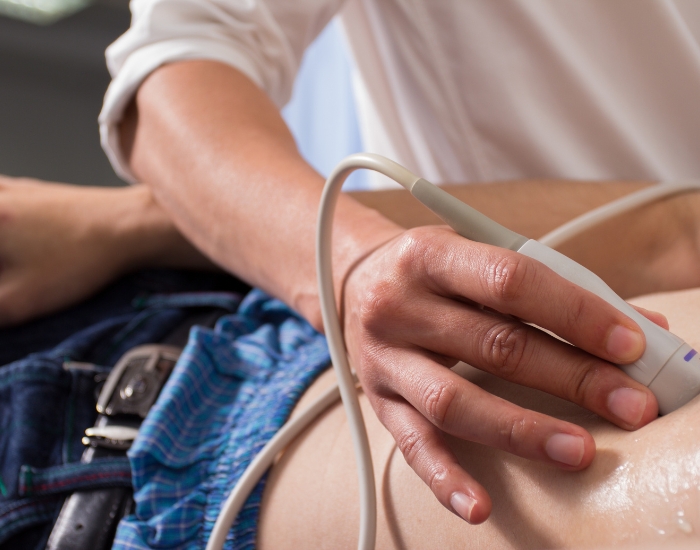
A resting ultrasound checks pumping function, wall thickness, and valves, and can show whether a region of the heart was damaged by a prior event.
Imaging Stress Test
When a plain treadmill EKG test was abnormal, a stress echo or nuclear study adds imaging and is often used to confirm or refute the result.
Coronary Calcium Score
A CT scan that measures calcified plaque in the coronary arteries. A score of zero makes significant disease unlikely and can help settle a borderline stress test.
Coronary CT Angiography
A contrast CT that visualizes the coronary arteries without a catheter. Useful for confirming or excluding narrowing in patients at intermediate risk; coordinated at an outside imaging facility.
Cardiac Catheterization
The definitive test. A thin catheter is guided to the coronary arteries in a hospital cath lab, and contrast dye shows any narrowing directly. Treatment with a stent can be performed during the same procedure when indicated.
Blood Tests
Cholesterol, glucose or A1c, kidney function, and a blood count help define risk and guide medication choices whatever the arteries show.
Management
Treatment Depends on the Underlying Cause
An abnormal stress test leads to one of a small number of plans, and which one applies depends on what the follow-up evaluation shows.
When coronary artery disease is confirmed but the narrowing is moderate and symptoms are controlled, treatment is medical: a statin, aspirin or another antiplatelet drug when appropriate, blood pressure control, and medication for angina if needed, along with attention to diet, exercise, weight, and smoking. This approach is effective for many patients and does not require a procedure.
When a significant blockage is causing symptoms or affecting a large area of heart muscle, angioplasty with stent placement or, for extensive disease, bypass surgery may be recommended. These decisions are made after catheterization, and Dr. Khalid explains the reasoning and the alternatives before anything is scheduled.
When the stress test proves to have been a false positive, the plan is reassurance and continued risk-factor management. If a non-coronary cause such as a valve or heart muscle problem is found, treatment follows that diagnosis. In every case, the goal is a plan you understand and a clear sense of what symptoms should prompt a call.
Your Visit
What to Expect During Your Cardiology Visit
Ask the facility that performed the stress test to send the full report and images, not just the summary. Bring any prior EKGs, echocardiograms, calcium scores, or catheterization reports, a complete medication list, and recent cholesterol and glucose results.
The visit covers your symptoms and exercise tolerance, your risk factors, a physical examination, and a resting EKG. Dr. Khalid will walk through the stress test findings with you and explain how likely they are to reflect real disease. If further testing is recommended, you will know which test, why it was chosen over the alternatives, and what each result would mean.
If catheterization is the next step, it is scheduled at the hospital, and you will receive instructions about medications, fasting, and what to expect on the day. Most patients leave the first visit with a clear plan and a timeline.
Katy Cardiology Care
Abnormal Stress Test Cardiologist in Katy, TX
Patients from Katy, Cinco Ranch, Fulshear, and West Houston come to the Grand Parkway office after a stress test ordered by a primary care physician, a pre-operative clinic, or an emergency room returned abnormal. Because an abnormal result can mean significant disease, these visits are scheduled promptly; mention the result when you call.
The office obtains resting EKGs and echocardiograms and arranges imaging stress tests, calcium scoring, and CT angiography, with catheterization coordinated at an area hospital when indicated. For other services at this location, see cardiology care in Katy.
Advanced Cardiology – Katy
410 W Grand Pkwy S Ste 4D
Katy, TX 77494
Phone: (713) 258-6111
Advanced Cardiology – Sugar Land
7102 Tarrington Ave Suite 505
Sugar Land, TX 77479
Phone: (713) 258-6111
Sugar Land Cardiology Care
Abnormal Stress Test Cardiologist in Sugar Land, TX
At the Tarrington Avenue office, Dr. Khalid sees patients from Sugar Land, Richmond, Rosenberg, Missouri City, and Stafford whose stress test was flagged, including many with diabetes or high blood pressure, in whom an abnormal result is more likely to reflect real coronary disease. Patients who were told to “follow up with cardiology” and are unsure how urgent that is are encouraged to call and ask.
The office performs EKGs and echocardiograms and coordinates confirmatory imaging and, when needed, catheterization at a nearby hospital, so the path from an abnormal result to a definitive answer is short. Learn more about cardiology care in Sugar Land.
Serving Greater Houston
Serving Patients Across Greater Houston
Patients come to the Katy and Sugar Land offices from across Greater Houston, including Cypress, Richmond, Rosenberg, Fulshear, and West Houston, for follow-up after an abnormal stress test. Both offices offer the same physician and the same approach; choose the one that is easier to reach, and the scheduling team can help if you are unsure.
Patient-Centered Cardiology
Why Patients Choose Advanced Cardiology
Interventional Cardiology Training
Fellowship training in the subspecialty that evaluates and treats coronary blockages, so the whole path from stress test to treatment is under one physician.
Careful Result Review
Stress test images and tracings are reviewed directly, and false positives are identified before anyone is sent for a catheterization they do not need.
Timely Follow-Up
Abnormal results are seen promptly, and confirmatory testing or catheterization is coordinated without long delays.
Clear Patient Communication
You understand what the result means, what each option involves, and why one path is recommended over another.
Two Convenient Locations
Offices in Katy and Sugar Land serving surrounding Greater Houston communities.
New Patients Welcome
New patients are welcome. Most major insurance plans are accepted, subject to eligibility and coverage verification.
Common Questions
Frequently Asked Questions About Abnormal Stress Tests
What does a positive stress test mean?
It means the heart showed a change under exertion, most often an EKG shift, a blood-flow defect, or a wall-motion abnormality, that can indicate a narrowed coronary artery. It raises the probability of coronary artery disease but does not confirm it, which is why the result is interpreted alongside your symptoms and risk factors before any decision is made.
Does an abnormal stress test mean I have blocked arteries?
No. Stress tests have a meaningful false-positive rate, particularly in women, in patients with baseline EKG abnormalities, and in those taking certain medications. Some abnormal results reflect small-vessel disease, artery spasm, valve or heart muscle conditions, or imaging artifact rather than a fixed blockage. Confirmation with another test is common before proceeding to catheterization.
What happens after an abnormal stress test?
It depends on how likely the result is to be real. When the probability of significant disease is high, catheterization may be the next step. When the picture is uncertain, a stress echo, nuclear study, coronary calcium score, or CT angiography is often used first. When the result is probably a false positive, the plan is risk-factor management and observation.
How soon should I see a cardiologist after an abnormal stress test?
Ideally within days. Stress test findings that involve a large area of heart muscle, symptoms during the test, or a drop in blood pressure warrant prompt evaluation. Even a mildly abnormal result should be reviewed within a few weeks. Mention the result when you call so the appointment can be prioritized.
Will I need a cardiac catheterization?
Not always. Many patients with an abnormal stress test are evaluated with non-invasive imaging first, and some are managed with medication without ever needing a catheterization. Catheterization is recommended when the probability of a significant blockage is high enough that direct visualization, and possibly treatment, is the most useful next step.
Can a stress test be wrong?
Yes, and it happens regularly. Baseline EKG changes, certain medications, poor exercise effort, rapid breathing, breast or diaphragm shadowing on nuclear images, and electrolyte shifts can all produce an abnormal-looking result in a healthy heart. Women have higher false-positive rates on treadmill EKG tests, which is one reason imaging stress tests are often preferred.
Can I exercise after an abnormal stress test?
Unless your cardiologist has told you otherwise, avoid strenuous exertion until you have been seen, and do not ignore chest discomfort, breathlessness, or fatigue with activity. Continue your usual medications. Call 911 for chest pain at rest, pain that spreads to the arm or jaw, sweating, nausea, or fainting.
What is the difference between a treadmill test, a nuclear stress test, and a stress echo?
A treadmill EKG stress test tracks the heart's electrical activity and blood pressure during exercise. A nuclear stress test adds a tracer that maps blood flow to the heart muscle, and a stress echocardiogram adds ultrasound images of the heart's motion. The imaging tests are more accurate and are often used to confirm an abnormal treadmill result.
Keep Reading
Related Heart Health Resources
- What Are Signs of Blocked Arteries in the Heart?
- Signs of a Silent Heart Attack You Should Never Ignore
- Can Acid Reflux Feel Like a Heart Attack?
- What Does a Heart Attack Feel Like in Women?
Related services: Exercise Stress Testing • Stress Echocardiography • Nuclear Cardiac Testing • Coronary Calcium Scan • Cardiac Catheterization • Interventional Cardiology • Chest Pain Evaluation
Medical Review: Adnan Khalid, MD
Cardiology Appointments
Take the Next Step
If your stress test came back abnormal, the next step is a cardiology visit that puts the result in context and maps out what, if anything, needs to happen. Adnan Khalid, MD welcomes new patients at Advanced Cardiology's Katy and Sugar Land offices.
Katy: 410 W Grand Pkwy S Ste 4D, Katy, TX 77494
Sugar Land: 7102 Tarrington Ave Suite 505, Sugar Land, TX 77479
Chest pain at rest, pain spreading to the arm or jaw, sweating, nausea, severe shortness of breath, or fainting after an abnormal stress test may be a heart attack. Call 911.