
Cardiac Testing
EKG Testing in Katy & Sugar Land, TX
An electrocardiogram (EKG or ECG) is the fastest, simplest, and most widely used heart test there is. In about ten minutes, without needles or radiation, it records the heart's electrical activity and shows whether the rhythm is regular, whether the electrical signal is traveling normally, and whether there are signs of strain, prior damage, or reduced blood flow. At Advanced Cardiology, Adnan Khalid, MD performs EKGs in the office, reads them personally, and uses them as the starting point for evaluating chest pain, palpitations, breathlessness, dizziness, and high blood pressure.
EKGs are performed at both the Katy and Sugar Land offices, usually during the same visit as your consultation.
Board-Certified Cardiologist • Katy & Sugar Land • New Patients Welcome
Important Safety Information
When Not to Wait for an Office EKG
An office EKG is for stable symptoms. If you have chest pain or pressure right now, especially with shortness of breath, sweating, nausea, or pain spreading to the arm, jaw, or back, or if you have fainted or your heart is racing and will not slow down, call 911. Emergency departments perform EKGs within minutes of arrival, and a heart attack is treated by the clock.
About the Test
What Is an EKG?
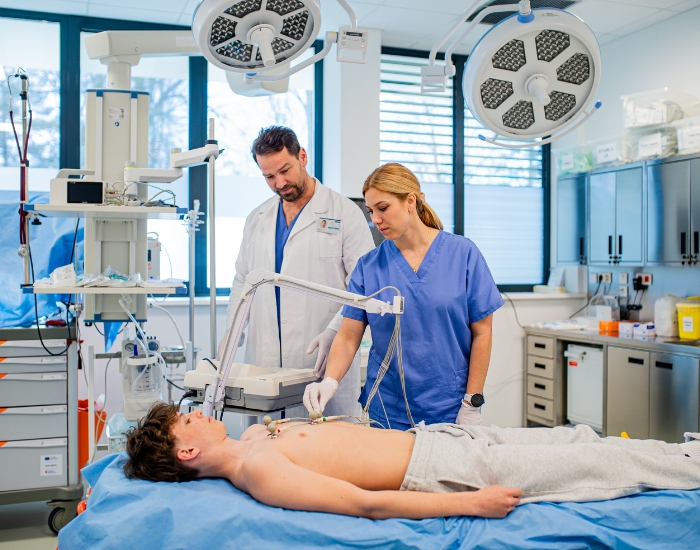
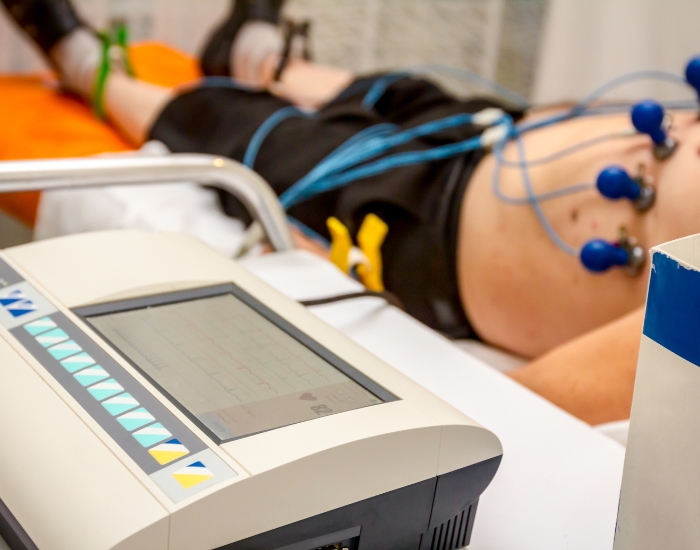
Every heartbeat begins with an electrical impulse that spreads through the heart in a predictable sequence, first across the upper chambers, then down through the conduction system to the lower chambers. An EKG picks up that electrical activity through small adhesive electrodes placed on the chest, arms, and legs and draws it as a tracing. Twelve views, or leads, look at the heart from different angles, which is why a standard test is called a 12-lead EKG.
The tracing tells a cardiologist several things at once: how fast the heart is beating and whether the rhythm is regular; whether the electrical signal is delayed or blocked anywhere along its path; whether the heart's chambers are enlarged or thickened; whether part of the heart muscle is not receiving enough blood; and whether there is evidence of a prior heart attack.
The test takes about ten minutes, most of which is placing the electrodes. The recording itself captures roughly ten seconds. That brevity is the EKG's one limitation: it shows what the heart is doing at that moment, so rhythm problems that come and go may need a longer recording with a Holter or event monitor.
When It Is Recommended
When Is an EKG Recommended?
An EKG is the first cardiac test for almost any heart-related symptom and is also used as a baseline in people without symptoms. Dr. Khalid recommends one when:
- You have chest pain, pressure, or tightness, particularly with exertion
- You notice palpitations, a racing or irregular heartbeat, or skipped beats
- You have shortness of breath, reduced stamina, or unexplained fatigue
- You have had dizziness, near-fainting, or fainting
- You have high blood pressure, diabetes, or high cholesterol and need a baseline
- A smartwatch or blood pressure cuff has flagged an irregular rhythm
- You are being cleared for surgery
- You take medications that can affect heart rhythm and need monitoring
- You have a family history of sudden cardiac death or an inherited heart condition
Patients with an existing heart condition have EKGs at intervals to track changes over time, and a prior tracing on file is one of the most valuable things a cardiologist can have when a new symptom appears.
What It Detects
What an EKG Can Show
A single ten-second tracing carries a surprising amount of information. These are the findings a cardiologist looks for.
Heart Rhythm Disorders
Atrial fibrillation, atrial flutter, SVT, premature beats, and slow rhythms are identified directly when they are present during the recording.
Conduction Problems
Delays or blocks in the electrical pathway, such as AV block or bundle branch block, show up as characteristic patterns.
Reduced Blood Flow
ST-segment and T-wave changes can indicate that part of the heart is not getting enough blood, especially on a tracing taken during symptoms.
Prior Heart Attack
Q waves and other changes leave a lasting record of a previous heart attack, including ones that went unnoticed.
Chamber Enlargement
Voltage patterns suggest a thickened left ventricle from long-standing high blood pressure or an enlarged atrium that predisposes to atrial fibrillation.
Inherited Electrical Patterns
Prolonged QT, Brugada pattern, and pre-excitation (Wolff-Parkinson-White) are inherited electrical conditions visible on a resting tracing.

Meet Your Cardiologist
EKG Interpretation by Adnan Khalid, MD
Adnan Khalid, MD is a board-certified cardiologist with fellowship training in cardiovascular disease, interventional cardiology, and advanced heart failure and transplant cardiology. An EKG is only as useful as the reading behind it. Automated machine interpretations flag many normal variants as abnormal and occasionally miss subtle findings; Dr. Khalid reads every tracing himself and interprets it in the context of your symptoms, history, and any prior EKGs.
The EKG is rarely the end of the evaluation. When it raises a question, he chooses the test that answers it: a Holter or event monitor for intermittent rhythm symptoms, an echocardiogram for structural findings, or stress testing when reduced blood flow is suspected. When the tracing is normal and reassuring, he explains that too, along with what a normal EKG does and does not exclude.
The Test
What to Expect During an EKG
No preparation is needed. Eat and take your medications as usual. Wear a top that is easy to remove or open, and avoid oily lotions on the chest, which can interfere with electrode contact. Let the staff know if you have a pacemaker or defibrillator.
You will lie on an exam table while a technician places ten small adhesive electrodes on your chest, arms, and legs. Men with chest hair may have small patches shaved so the electrodes stick. You lie still and breathe normally for a few seconds while the machine records. The electrodes are then removed. The whole process takes about ten minutes, and there is no discomfort beyond the adhesive.
Because the EKG is performed in the office, Dr. Khalid can review it during the same visit and discuss the result with you before you leave. If the tracing shows something that needs a longer look, a monitor or echocardiogram can be arranged on the spot.
Your Results
Understanding Your EKG Results
A normal EKG shows a regular rhythm at a normal rate, with electrical signals traveling in the expected sequence and no signs of strain, enlargement, or prior damage. It is reassuring, but it captures only a few seconds and does not rule out coronary artery disease or intermittent rhythm problems; if symptoms continue, further evaluation is reasonable.
An abnormal EKG covers a wide range. Some findings are harmless variations or technical artifacts that resolve on a repeat tracing. Others, such as atrial fibrillation, heart block, a prolonged QT interval, or evidence of a prior heart attack, change what happens next. Dr. Khalid explains what was found, whether it matters, and what test, if any, should follow. Read more about what an abnormal EKG means.
Every EKG is kept on file. Comparison with earlier tracings is often the most useful part of a future evaluation.
Related Testing
Tests That May Follow an EKG
The EKG often points to the next question. These are the tests most commonly used to answer it.
Holter Monitor
A wearable recorder worn for one to fourteen days, for rhythm symptoms that come and go and were not present during the office EKG. Learn about Holter monitoring.
Event Monitor
Worn for up to 30 days and records during symptoms, for episodes that occur weekly or less often. Learn about event monitoring.
Echocardiogram
An ultrasound of the heart's structure and pumping function, used when the EKG suggests enlargement, prior damage, or a valve problem. Learn about echocardiography.
Stress Testing
An EKG recorded during exercise or medication-induced stress, to evaluate blood flow when symptoms occur with exertion. Learn about stress testing.
Blood Tests
Electrolytes, thyroid function, and a blood count identify reversible causes of rhythm changes seen on the tracing.
Cardiac CT
A calcium score or CT angiography when the EKG and risk profile raise the question of coronary artery disease. Coordinated at an outside facility.
Katy Cardiology Care
EKG Testing in Katy, TX
Patients from Katy, Cinco Ranch, Fulshear, and West Houston have EKGs at the Grand Parkway office as part of a cardiology consultation, for a pre-surgical requirement, or to follow up an irregular rhythm flagged by a smartwatch or a primary care visit. The test is performed and read on site, usually in the same visit, and same-week appointments are generally available.
If your primary care physician has ordered an EKG with cardiology follow-up, bring the referral; if you have prior EKGs from another provider, bring those too. For other services at this location, see cardiology care in Katy.
Advanced Cardiology – Katy
410 W Grand Pkwy S Ste 4D
Katy, TX 77494
Phone: (713) 258-6111
Advanced Cardiology – Sugar Land
7102 Tarrington Ave Suite 505
Sugar Land, TX 77479
Phone: (713) 258-6111
Sugar Land Cardiology Care
EKG Testing in Sugar Land, TX
At the Tarrington Avenue office, EKGs are performed for patients from Sugar Land, Richmond, Rosenberg, Missouri City, and Stafford as part of cardiology consultations, preoperative evaluations, and routine follow-up of high blood pressure, diabetes, and known heart conditions. Results are reviewed by Dr. Khalid during the visit.
When the tracing calls for a longer look, Holter and event monitors are arranged from the office and echocardiography is available on site. Learn more about cardiology care in Sugar Land.
Serving Greater Houston
Serving Patients Across Greater Houston
Patients come to the Katy and Sugar Land offices from across Greater Houston, including Cypress, Richmond, Rosenberg, Fulshear, and West Houston, for EKG testing and cardiology consultation. Both offices perform and read EKGs on site; choose the one that is easier to reach, and the scheduling team can help if you are unsure.
Patient-Centered Cardiology
Why Patients Choose Advanced Cardiology for EKG Testing
Cardiologist-Read Results
Every tracing is read by Adnan Khalid, MD, not left to the machine's automated interpretation.
Same-Visit Results
The EKG is performed and reviewed during your consultation, so you leave with an answer rather than a wait.
Next Steps Without Delay
When the tracing raises a question, Holter, event monitor, and echocardiography are arranged from the same office.
Clear Patient Communication
You see your own tracing and learn what it shows, what it does not, and what happens next.
Two Convenient Locations
Offices in Katy and Sugar Land serving surrounding Greater Houston communities.
New Patients Welcome
New patients are welcome. Most major insurance plans are accepted, subject to eligibility and coverage verification.
Common Questions
Frequently Asked Questions About EKG Testing
What is the difference between an EKG and an ECG?
Nothing. EKG and ECG are the same test; EKG comes from the German spelling of electrocardiogram and ECG from the English. Both refer to the standard 12-lead recording of the heart's electrical activity.
How long does an EKG take?
About ten minutes in total. Placing the electrodes takes most of that time; the recording itself lasts around ten seconds. There is no recovery period, and you can return to normal activity immediately.
Does an EKG hurt?
No. The electrodes only record electrical signals from the skin; nothing is sent into the body. The only sensation is the adhesive patches, and occasionally a small area of chest hair is shaved so they stick properly.
Can an EKG detect blocked arteries?
Sometimes, but not reliably. A resting EKG can show signs of a prior heart attack or of reduced blood flow during symptoms, but a normal EKG does not exclude coronary artery disease. Stress testing, calcium scoring, or CT angiography are the tests that evaluate the arteries themselves.
What does a normal EKG mean?
It means the rhythm, rate, and electrical pattern were within normal limits during the ten seconds recorded. It is reassuring but not a guarantee: intermittent rhythm problems and coronary artery disease can both be present with a normal resting tracing. If symptoms continue, further evaluation is reasonable.
Does an abnormal EKG mean I have heart disease?
Not necessarily. Many abnormal readings are normal variants, technical artifacts, or minor findings that need no treatment. Others, such as atrial fibrillation or heart block, do matter. A cardiologist reading the tracing in context can tell you which applies. See our page on abnormal EKG results for more detail.
How often should I have an EKG?
There is no fixed schedule for healthy adults. A baseline EKG is reasonable around age 40 or when risk factors such as high blood pressure or diabetes are present. Patients with a known heart condition, or on medications that affect the heart, have EKGs at intervals set by their cardiologist.
Is a smartwatch EKG as good as one in the office?
Consumer devices record a single lead and can detect atrial fibrillation reasonably well, but they cannot replace a 12-lead EKG, which views the heart from twelve angles and detects conduction problems, prior damage, and blood flow changes. A smartwatch alert is a good reason to have a proper EKG, not a substitute for one.
Do I need to prepare for an EKG?
No. Eat, drink, and take your medications as usual. Wear clothing that allows easy access to your chest, skip oily lotions on the chest that day, and tell the staff if you have a pacemaker or defibrillator. Bring any prior EKGs from other providers for comparison.
What is the difference between an EKG and a Holter monitor?
A standard EKG records about ten seconds while you lie still. A Holter monitor records continuously for one to fourteen days, and an event monitor for up to 30 days. They are used when symptoms are intermittent and the office EKG was normal, so the rhythm can be captured during an actual episode.
Keep Reading
Related Heart Health Resources
- What Do Heart Palpitations Feel Like? When to Worry
- What Are Signs of Blocked Arteries in the Heart?
- Signs of a Silent Heart Attack You Should Never Ignore
- Why Is My Heart Racing Suddenly?
Related services: Abnormal EKG Evaluation • Holter Monitor • Event Monitor • Echocardiography • Stress Testing • Chest Pain Evaluation • Preoperative Cardiac Clearance
Medical Review: Adnan Khalid, MD
Cardiology Appointments
Schedule an EKG
If you have symptoms that could involve your heart, or need a baseline or pre-surgical EKG, Adnan Khalid, MD performs and reads EKGs in the office at Advanced Cardiology's Katy and Sugar Land locations. New patients are welcome.
Katy: 410 W Grand Pkwy S Ste 4D, Katy, TX 77494
Sugar Land: 7102 Tarrington Ave Suite 505, Sugar Land, TX 77479
Chest pain, fainting, or a racing heartbeat that will not stop is an emergency. Call 911.