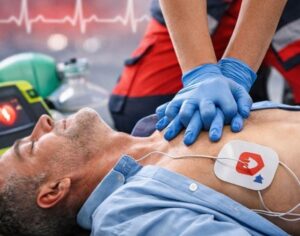
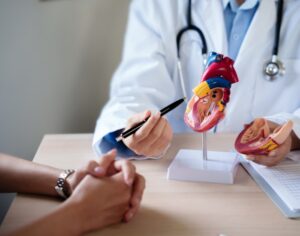
A heart that suddenly races is most often reacting to adrenaline from stress or anxiety, caffeine, dehydration, fever, alcohol or a medicine. It can also be a heart rhythm problem such as SVT or atrial fibrillation, which start and stop abruptly. Call 911 if a racing heart comes with chest pain, fainting, severe breathlessness or does not settle.

Medically reviewed by
Board-certified cardiologist · Katy & Sugar Land, TX
Fellowship-trained in cardiovascular disease, interventional cardiology, echocardiography and advanced heart failure and transplant cardiology. Former Assistant Professor of Cardiology at McGovern Medical School.
What counts as a racing heart?
A normal resting heart rate for adults is generally 60 to 100 beats per minute. A rate above 100 at rest is called tachycardia. A fast heartbeat during exercise, fear or excitement is normal; a heart that suddenly races while you are sitting still, or that feels irregular, deserves attention.
Why is my heart racing suddenly?
Causes fall into two groups: the heart responding normally to something in the body (sinus tachycardia), and an abnormal electrical rhythm.
| Cause | Typical clues |
|---|---|
| Stress, anxiety or panic | Builds with worry, often with fast breathing, tingling and fear |
| Caffeine, energy drinks, nicotine, alcohol | Follows intake; worse with large amounts or poor sleep |
| Dehydration, fever, infection | Thirst, heat, illness; heart rate rises gradually |
| Medicines and supplements | Decongestants, asthma inhalers, thyroid medicine, some weight loss products |
| Anemia or overactive thyroid | Ongoing fast pulse, fatigue, weight change, heat intolerance |
| Low blood sugar | Shaky, sweaty, hungry; diabetes medicines |
| Supraventricular tachycardia (SVT) | Starts and stops suddenly like a switch, often 150 to 250 bpm, regular |
| Atrial fibrillation or flutter | Fast and irregular, fluttering, breathlessness, fatigue |
| Ventricular tachycardia | Very fast, often with dizziness, fainting or chest pain; may occur with heart disease |
| POTS | Heart rate jumps on standing, with lightheadedness |
- Chest pain or pressure
- Fainting or nearly fainting
- Severe shortness of breath
- Confusion or one-sided weakness
- A very fast rate that does not slow down after several minutes of rest
Heart rhythm problems that cause a sudden racing heart
SVT is caused by an extra electrical pathway or circuit in the upper heart. Episodes start and stop abruptly and can last minutes to hours. It is usually not life-threatening in an otherwise healthy heart, but it is uncomfortable and treatable with medicine or catheter ablation (coordinated with an electrophysiology team).
Atrial fibrillation causes a fast, irregular heartbeat and raises stroke risk, so it always needs evaluation.
Ventricular tachycardia starts in the lower chambers and can be dangerous, especially in people with prior heart attacks or weak heart muscle.
The NHLBI explains that arrhythmias can cause palpitations, dizziness, fainting, breathlessness and chest pain. Learn more about rapid heart rate (tachycardia).
Heart racing at night or when lying down
Many people first notice a racing or pounding heart in bed, when it is quiet and they lie on their left side. Common triggers include late caffeine or alcohol, anxiety, reflux and sleep apnea. Rhythm problems such as SVT and atrial fibrillation can also start at night. Untreated sleep apnea is strongly linked to atrial fibrillation; loud snoring, gasping and daytime sleepiness are worth discussing with your doctor.
What to do when your heart starts racing
- Sit down and breathe slowly.
- Check your pulse or smartwatch: note the rate and whether it is regular.
- If your doctor has taught you vagal maneuvers for diagnosed SVT, you can try them.
- Call 911 for any warning sign below.
- If it settles, write down when it happened, how long it lasted and what you were doing, and arrange a doctor visit. A smartwatch EKG strip can be helpful to bring.
How doctors diagnose a racing heart
The most useful information is a recording of the rhythm during symptoms. A cardiologist may use an EKG, a Holter monitor (24 to 48 hours), an event monitor or mobile cardiac telemetry for several weeks, a rhythm strip, blood tests for thyroid, anemia and electrolytes, and an echocardiogram to check heart structure.
Treatment options
Treatment depends on the cause: reducing caffeine and alcohol, treating anxiety, anemia or thyroid disease, medicines that slow the heart or control rhythm, blood thinners for atrial fibrillation when stroke risk warrants, cardioversion to reset certain rhythms, and catheter ablation for SVT or atrial fibrillation in selected patients.
Palpitation and racing heart care in Katy and Sugar Land
Advanced Cardiology evaluates racing heartbeats and palpitations at our Katy and Sugar Land offices. Dr. Khalid can review smartwatch recordings, perform an EKG in the office and start a heart monitor to capture episodes. See our heart palpitations doctor and irregular heartbeat pages.
Katy office: 410 W Grand Pkwy S, Suite 4D, Katy, TX 77494
Sugar Land office: 7102 Tarrington Ave, Suite 505, Sugar Land, TX 77479
Phone: (713) 258-6111
We also see patients from Fulshear, Richmond, Rosenberg, Stafford, Missouri City and west Houston.
Heart racing out of nowhere?
Capture the rhythm and get answers. Request a cardiology visit in Katy or Sugar Land.
Having symptoms right now? Call 911. Do not wait for an appointment.
Frequently asked questions
Why is my heart racing suddenly while resting?
Common causes include anxiety, caffeine, dehydration, fever and medicines. Rhythm problems such as SVT or atrial fibrillation can also cause sudden racing at rest and need evaluation.
When should I worry about a racing heart?
Seek emergency care if it comes with chest pain, fainting, severe breathlessness or confusion, or does not slow down. See a doctor for repeated episodes.
Can anxiety make your heart race?
Yes. Anxiety releases adrenaline, which speeds up the heart. Anxiety-related racing usually builds gradually, while SVT tends to start and stop suddenly.
What heart rate is too high at rest?
A resting rate above 100 beats per minute is considered fast. Rates above 150, or any fast rate with symptoms, should be evaluated promptly.
Can dehydration cause a racing heart?
Yes. Low fluid volume makes the heart beat faster to maintain blood pressure, especially in hot weather or with illness.
Why does my heart race at night?
Late caffeine or alcohol, anxiety, reflux, sleep apnea and rhythm problems can all cause a racing heart at night.
How do doctors find out why my heart races?
By recording the rhythm during symptoms using an EKG, Holter monitor, event monitor or mobile telemetry, along with blood tests and an echocardiogram.
Trusted health resources
- Arrhythmias, National Heart, Lung, and Blood Institute (NIH)
- Arrhythmia, MedlinePlus, U.S. National Library of Medicine
- Anxiety, MedlinePlus, U.S. National Library of Medicine
- Dehydration, MedlinePlus, U.S. National Library of Medicine
Medical disclaimer: This article is for general education and is not a diagnosis or a substitute for care from your own doctor. If you think you may be having a heart attack, stroke or another emergency, call 911 right away.