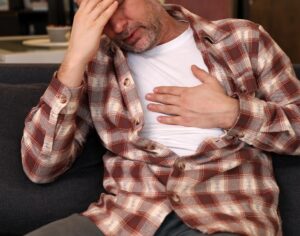
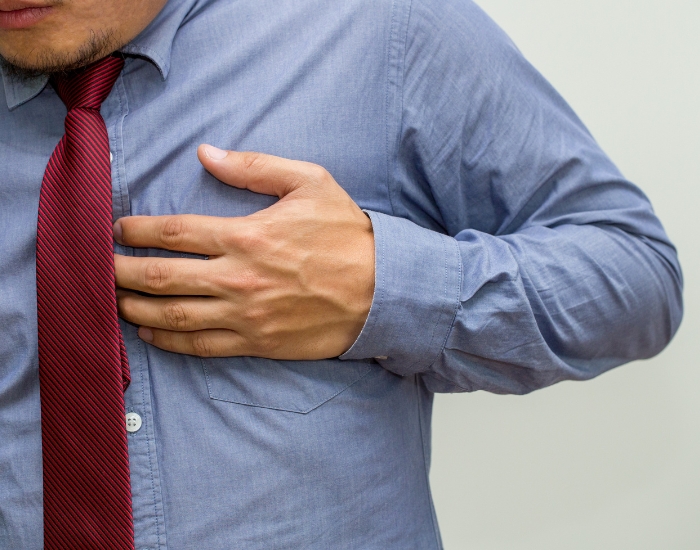
Yes, heart failure can cause chest pain or pressure, but it is not its most typical symptom. Chest discomfort in heart failure usually comes from coronary artery disease (angina), a heart working harder than its blood supply allows, fluid buildup, rhythm problems or valve disease. New or worsening chest pain in someone with heart failure should be checked promptly, and severe pain needs 911.

Medically reviewed by
Board-certified cardiologist · Katy & Sugar Land, TX
Fellowship-trained in cardiovascular disease, interventional cardiology, echocardiography and advanced heart failure and transplant cardiology. Former Assistant Professor of Cardiology at McGovern Medical School.
How heart failure and chest pain are connected
Heart failure and chest pain often share the same root cause. Coronary artery disease is the most common cause of heart failure with reduced ejection fraction: a heart attack or long-standing reduced blood flow weakens the muscle, and the same narrowed arteries can cause angina. Even without blocked arteries, a weak, enlarged or thickened heart needs more oxygen, and when it cannot get enough during exertion or fast heart rates, chest discomfort can occur.
Causes of chest pain in people with heart failure
Different patterns point to different causes:
| Cause | Typical pattern |
|---|---|
| Angina from coronary artery disease | Pressure or tightness with exertion or stress, relieved by rest |
| Heart attack | Pressure lasting more than a few minutes, sweating, nausea, breathlessness |
| Fluid overload | Chest heaviness with breathlessness, worse lying flat, swelling and weight gain |
| Fast heart rhythms such as atrial fibrillation | Chest discomfort with palpitations and breathlessness |
| Aortic stenosis | Chest pain, breathlessness or dizziness with exertion |
| Hypertrophic cardiomyopathy | Chest pain with exertion despite normal coronary arteries |
| Pericarditis or myocarditis | Sharp pain, sometimes worse lying down or breathing |
| Non-heart causes | Reflux, muscle strain, lung infections or blood clots |
- Chest pain or pressure lasting more than a few minutes, or not relieved by your prescribed nitroglycerin as instructed
- Chest pain with sweating, nausea, fainting or severe breathlessness
- Breathlessness at rest or pink, frothy mucus
- A racing, irregular heartbeat with chest pain or dizziness
Heart failure symptoms that often come with chest discomfort
- Shortness of breath with activity or when lying flat.
- Swelling in the legs, ankles or abdomen.
- Rapid weight gain from fluid.
- Fatigue and reduced exercise tolerance.
- Palpitations or a fast, irregular heartbeat.
Read early signs of heart failure and chest tightness with shortness of breath.
How doctors evaluate chest pain with heart failure
Evaluation often includes an EKG, troponin and BNP blood tests, an echocardiogram to check pumping and valves, and testing for coronary disease such as a nuclear stress test, CT angiography or cardiac catheterization. Finding and treating blocked arteries can relieve chest pain and, in some cases, improve heart function.
Treatment
- Guideline-directed heart failure medicines; several, such as beta blockers, also reduce angina. See heart failure treatment options.
- Anti-anginal medicines such as nitrates or ranolazine when appropriate.
- Diuretics to relieve fluid-related chest heaviness.
- Angioplasty and stenting or bypass surgery for significant blockages.
- Rate or rhythm control for atrial fibrillation.
- Valve repair or replacement when a valve is the cause.
- Risk factor control: blood pressure, cholesterol, diabetes and not smoking.
Note: some erectile dysfunction medicines must never be combined with nitrates; always tell your doctors about all medicines.
Heart failure and chest pain care in Katy and Sugar Land
Dr. Adnan Khalid is a fellowship-trained interventional cardiologist who also completed training in advanced heart failure and transplant cardiology, so he can evaluate both the heart muscle and the coronary arteries. He sees patients at our Katy and Sugar Land offices, with EKG and echocardiogram testing in the office and catheter-based procedures at affiliated hospitals. See our heart failure and chest pain pages.
Katy office: 410 W Grand Pkwy S, Suite 4D, Katy, TX 77494
Sugar Land office: 7102 Tarrington Ave, Suite 505, Sugar Land, TX 77479
Phone: (713) 258-6111
We also see patients from Fulshear, Richmond, Rosenberg, Stafford, Missouri City and west Houston.
Heart failure with new or worsening chest pain?
Have your arteries and heart function checked. Request a visit in Katy or Sugar Land.
Having symptoms right now? Call 911. Do not wait for an appointment.
Frequently asked questions
Can heart failure cause chest pain?
Yes. Chest pain in heart failure usually comes from coronary artery disease, a strained heart, fluid buildup, rhythm problems or valve disease. New or worsening chest pain should be evaluated.
What does heart failure chest pain feel like?
Often pressure, tightness or heaviness, sometimes with breathlessness, especially with exertion or when lying flat.
Is chest pain a sign heart failure is getting worse?
It can be, especially with more breathlessness, swelling or weight gain. It may also signal angina or a heart attack. Contact your doctor promptly, or call 911 for severe symptoms.
Can fluid around the heart or lungs cause chest pain?
Fluid buildup can cause chest heaviness and breathlessness. Fluid around the heart (pericardial effusion) can cause pressure or sharp pain.
How is chest pain treated in heart failure?
By treating the cause: heart failure medicines, anti-anginal medicines, diuretics, opening blocked arteries, controlling rhythm and repairing valves.
Should I go to the ER for chest pain if I have heart failure?
Call 911 if chest pain lasts more than a few minutes, comes with sweating, nausea, fainting or severe breathlessness, or does not respond to prescribed nitroglycerin.
Trusted health resources
- Heart Failure: Symptoms, National Heart, Lung, and Blood Institute (NIH)
- Stable angina, MedlinePlus Medical Encyclopedia
- Coronary Heart Disease, National Heart, Lung, and Blood Institute (NIH)
- Heart Failure, MedlinePlus, U.S. National Library of Medicine
Medical disclaimer: This article is for general education and is not a diagnosis or a substitute for care from your own doctor. If you think you may be having a heart attack, stroke or another emergency, call 911 right away.