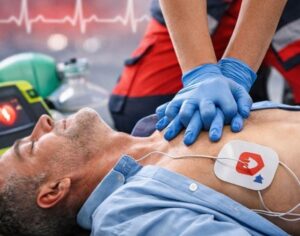
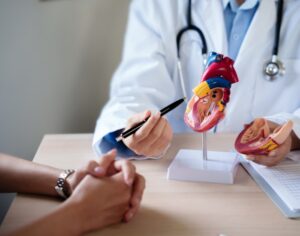
The most common signs of blocked arteries in the heart are chest pressure or tightness with exertion (angina), shortness of breath, unusual fatigue, and discomfort in the arm, jaw, neck or back that eases with rest. Many people have no symptoms until a heart attack. A cardiologist can find blockages with stress testing, a coronary calcium scan, CT angiography or cardiac catheterization.

Medically reviewed by
Board-certified cardiologist · Katy & Sugar Land, TX
Fellowship-trained in cardiovascular disease, interventional cardiology, echocardiography and advanced heart failure and transplant cardiology. Former Assistant Professor of Cardiology at McGovern Medical School.
What are blocked heart arteries?
The coronary arteries supply the heart muscle with oxygen-rich blood. Over years, cholesterol-rich plaque builds up inside their walls, a process called atherosclerosis. As plaque grows, it narrows the artery and limits blood flow, especially when the heart works harder. This is coronary artery disease (CAD), the most common type of heart disease. If a plaque ruptures, a clot can form and suddenly block the artery, causing a heart attack.
Signs of blocked arteries in the heart
- Angina: chest pressure, squeezing, heaviness or tightness that comes with walking, stairs, cold weather, heavy meals or stress and eases within minutes of rest. Learn about angina.
- Shortness of breath with activity, sometimes without chest pain.
- Unusual fatigue or reduced exercise tolerance.
- Discomfort in the arm, shoulder, jaw, neck, back or upper stomach, often with exertion.
- Nausea, sweating or lightheadedness with effort.
- Palpitations or an irregular heartbeat.
The NHLBI notes that some people with coronary heart disease have no symptoms, and the first sign may be a heart attack. Women, older adults and people with diabetes more often have subtle symptoms. Read signs of a silent heart attack.
Stable vs. unstable symptoms
Doctors pay close attention to the pattern of symptoms:
| Pattern | What it may mean | What to do |
|---|---|---|
| Predictable chest discomfort with the same level of exertion, relieved by rest | Stable angina from a fixed narrowing | Prompt cardiology evaluation |
| Angina that is new, more frequent, triggered by less effort or occurs at rest | Unstable angina: a plaque may be unstable | Same-day emergency evaluation |
| Chest pain lasting more than a few minutes with sweating, nausea or breathlessness | Possible heart attack | Call 911 |
- Chest pressure or pain lasting more than a few minutes or returning
- Angina at rest or angina that is suddenly worse
- Pain spreading to the arm, jaw, neck or back
- Shortness of breath, cold sweat, nausea or lightheadedness
Who is at risk?
- High LDL cholesterol or low HDL cholesterol. Learn about high cholesterol treatment.
- High blood pressure.
- Diabetes or prediabetes.
- Smoking or vaping.
- Obesity and physical inactivity.
- Family history of early heart disease (father or brother before 55, mother or sister before 65).
- Chronic kidney disease, inflammatory conditions and elevated hs-CRP.
- Older age.
Tests that find blocked arteries
- EKG: may show signs of reduced blood flow or a prior heart attack.
- Exercise stress test, stress echo or nuclear stress test: show whether part of the heart lacks blood flow during exertion.
- Coronary calcium scan: measures calcified plaque to estimate risk in people without symptoms.
- Coronary CT angiography: images the arteries directly.
- Cardiac catheterization: the most detailed test, which can also treat blockages.
Imaging such as CT and catheterization is coordinated with partner imaging centers and affiliated hospitals.
Treatment for blocked heart arteries
Treatment aims to relieve symptoms and prevent heart attacks:
- Lifestyle: stop smoking, follow a heart-healthy diet, stay active and manage weight.
- Medicines: statins and other cholesterol-lowering drugs, aspirin or other antiplatelet medicines when appropriate, blood pressure medicines and anti-anginal medicines.
- Procedures: angioplasty and stenting to open narrowed arteries, or bypass surgery for extensive disease.
- Cardiac rehabilitation after a heart attack or procedure.
Coronary artery disease care in Katy and Sugar Land
Dr. Adnan Khalid is a fellowship-trained interventional cardiologist who evaluates and treats coronary artery disease. At our Katy and Sugar Land offices we offer EKG and echocardiogram testing, arrange stress testing and imaging, and perform catheter-based procedures at affiliated hospitals when needed. Learn about our interventional cardiology services.
Katy office: 410 W Grand Pkwy S, Suite 4D, Katy, TX 77494
Sugar Land office: 7102 Tarrington Ave, Suite 505, Sugar Land, TX 77479
Phone: (713) 258-6111
We also see patients from Fulshear, Richmond, Rosenberg, Stafford, Missouri City and west Houston.
Chest tightness or breathlessness with activity?
These can be early signs of blocked arteries. Request a cardiology visit in Katy or Sugar Land.
Having symptoms right now? Call 911. Do not wait for an appointment.
Frequently asked questions
What are the first signs of blocked arteries in the heart?
Chest pressure or tightness with exertion, shortness of breath, unusual fatigue and discomfort in the arm, jaw, neck or back that eases with rest.
Can you have blocked arteries without symptoms?
Yes. Many people have no symptoms until a heart attack. A coronary calcium scan or other testing can find plaque early in people with risk factors.
How do doctors check for blocked arteries?
With an EKG, stress testing, coronary calcium scan, CT angiography and, when needed, cardiac catheterization.
Can blocked arteries be cleared without surgery?
Medicines, especially statins, and lifestyle changes can stabilize plaque and slow progression. Narrowed arteries causing symptoms may be opened with angioplasty and stents, a catheter procedure rather than open surgery.
What does angina feel like?
Usually pressure, squeezing or heaviness in the chest that comes with exertion or stress and fades with rest. It may spread to the arm, jaw or back.
Who should be screened for blocked arteries?
Adults with risk factors such as high cholesterol, high blood pressure, diabetes, smoking or a family history of early heart disease should discuss screening with their doctor.
Trusted health resources
- Coronary Heart Disease: Symptoms, National Heart, Lung, and Blood Institute (NIH)
- Coronary Heart Disease, National Heart, Lung, and Blood Institute (NIH)
- Coronary Artery Disease, MedlinePlus, U.S. National Library of Medicine
- Stable angina, MedlinePlus Medical Encyclopedia
- Atherosclerosis, National Heart, Lung, and Blood Institute (NIH)
Medical disclaimer: This article is for general education and is not a diagnosis or a substitute for care from your own doctor. If you think you may be having a heart attack, stroke or another emergency, call 911 right away.