To perform CPR on an adult: call 911, then push hard and fast in the center of the chest, about 2 inches deep at 100 to 120 compressions per minute, letting the chest rise fully between pushes. Keep going until help arrives or an AED is ready. Untrained bystanders should do hands-only CPR; trained rescuers can add 2 breaths after every 30 compressions.

Medically reviewed by
Board-certified cardiologist · Katy & Sugar Land, TX
Fellowship-trained in cardiovascular disease, interventional cardiology, echocardiography and advanced heart failure and transplant cardiology. Former Assistant Professor of Cardiology at McGovern Medical School.
When to start CPR
Cardiopulmonary resuscitation (CPR) keeps blood flowing to the brain and heart when the heart has stopped pumping, which is called sudden cardiac arrest. Start CPR when an adult:
- Collapses and does not respond when you tap their shoulders and shout.
- Is not breathing, or is only gasping (agonal breathing is not normal breathing).
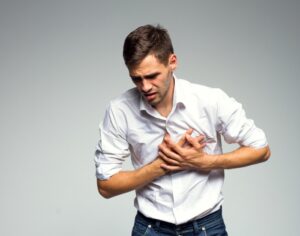
Cardiac arrest is different from a heart attack. A heart attack is a blood flow problem; the person is usually awake. Cardiac arrest is an electrical problem; the person is unresponsive. A heart attack can lead to cardiac arrest.
- Call 911 and put the phone on speaker
- Start hard, fast chest compressions in the center of the chest
- Send someone for an AED and use it as soon as it arrives
- Do not stop until help takes over or the person breathes normally
How to perform hands-only CPR on an adult
- Check the scene is safe, then check the person: tap and shout “Are you OK?”
- Call 911 or have someone call, put the phone on speaker, and send someone to find an AED (automated external defibrillator).
- Position your hands. Kneel beside the person, who should be on their back on a firm surface. Place the heel of one hand in the center of the chest on the lower half of the breastbone, and your other hand on top.
- Push hard and fast. Keep your arms straight and shoulders over your hands. Press down at least 2 inches (about 5 cm) but not more than about 2.4 inches, at a rate of 100 to 120 per minute. The beat of a song such as “Stayin’ Alive” matches this pace.
- Let the chest come all the way back up after each push and keep interruptions to a minimum.
- Use the AED as soon as it arrives. Turn it on and follow the voice prompts.
- Keep going until emergency responders take over, an AED tells you to stop, or the person starts breathing normally.
The 911 dispatcher can coach you through each step. Do not worry about hurting the person; without CPR, survival chances fall rapidly every minute.
CPR with rescue breaths (for trained rescuers)
If you are trained and willing, give cycles of 30 compressions followed by 2 rescue breaths: tilt the head back, lift the chin, pinch the nose, seal your mouth over theirs and give a breath over about one second, watching for the chest to rise. Then return immediately to compressions. If you are not trained or not comfortable, hands-only CPR is recommended for adults who suddenly collapse. The MedlinePlus encyclopedia describes the full sequence.
| Step | Adult CPR at a glance |
|---|---|
| Rate | 100 to 120 compressions per minute |
| Depth | At least 2 inches (5 cm), not more than about 2.4 inches |
| Hand position | Center of the chest, lower half of the breastbone |
| Recoil | Let the chest rise fully between compressions |
| Breaths (if trained) | 2 breaths after every 30 compressions |
| AED | Use as soon as available and follow prompts |
Children and infants need a different technique. The best way to learn is a hands-on class from a recognized provider such as the American Heart Association or American Red Cross.
How to use an AED
AEDs are found in many offices, schools, gyms, airports and stores. They are designed for untrained people. Open the case and turn it on, attach the pads to bare skin as shown on the pictures (one upper right chest, one lower left side), stand clear while it analyzes, and press the shock button only if the device tells you to. Resume compressions immediately after any shock or if no shock is advised.
What causes sudden cardiac arrest?
Most adult cardiac arrests are caused by a dangerous heart rhythm, such as ventricular fibrillation, often triggered by coronary artery disease or a heart attack. Other causes include a weakened heart muscle (cardiomyopathy or heart failure), inherited rhythm disorders, severe electrolyte problems, drug overdose and drowning. Warning signs that should be evaluated before a crisis include fainting, especially during exercise, unexplained racing heartbeat, chest pain with exertion and a family history of sudden death at a young age.
After cardiac arrest: protecting the heart
Survivors need a full cardiology evaluation to find and treat the cause. That may include coronary testing and stenting, medicines, and in some cases an implantable cardioverter-defibrillator (ICD), a device that can shock the heart back into rhythm. People at high risk because of a weak heart muscle (low ejection fraction) may also be considered for an ICD.
Heart rhythm and cardiac arrest risk care in Katy and Sugar Land
Advanced Cardiology does not teach CPR classes, but we help patients understand and lower their risk of sudden cardiac arrest. Dr. Khalid evaluates fainting, palpitations, weak heart muscle and family history of sudden death at our Katy and Sugar Land offices, with EKG, echocardiogram and heart rhythm monitoring available, and follows patients with ICDs and pacemakers.
Katy office: 410 W Grand Pkwy S, Suite 4D, Katy, TX 77494
Sugar Land office: 7102 Tarrington Ave, Suite 505, Sugar Land, TX 77479
Phone: (713) 258-6111
We also see patients from Fulshear, Richmond, Rosenberg, Stafford, Missouri City and west Houston.
Fainting, palpitations or a family history of sudden death?
These can be warning signs of a dangerous rhythm. Request a cardiology visit in Katy or Sugar Land.
Having symptoms right now? Call 911. Do not wait for an appointment.
Frequently asked questions
What are the steps to perform CPR on an adult?
Check responsiveness, call 911, get an AED, place your hands in the center of the chest, and push hard and fast about 2 inches deep at 100 to 120 per minute, letting the chest recoil. Use the AED as soon as it arrives.
What is hands-only CPR?
Hands-only CPR means continuous chest compressions without rescue breaths. It is recommended for untrained bystanders helping a teen or adult who suddenly collapses.
How many compressions per minute for CPR?
100 to 120 compressions per minute, at a depth of at least 2 inches for adults.
What is the ratio of compressions to breaths in CPR?
For trained rescuers giving adult CPR, the ratio is 30 compressions to 2 breaths.
Can you hurt someone by doing CPR?
Ribs can crack during effective CPR, but a person in cardiac arrest will not survive without circulation. The benefits far outweigh the risks.
Is a heart attack the same as cardiac arrest?
No. A heart attack is a blocked artery; the person is usually awake. Cardiac arrest is when the heart suddenly stops pumping effectively; the person collapses and is unresponsive. A heart attack can trigger cardiac arrest.
Where can I learn CPR?
Hands-on classes are offered by organizations such as the American Heart Association and the American Red Cross, and often by local hospitals and fire departments.
Trusted health resources
- CPR: adult and child after onset of puberty, MedlinePlus Medical Encyclopedia
- CPR, MedlinePlus, U.S. National Library of Medicine
- Arrhythmias, National Heart, Lung, and Blood Institute (NIH)
- Heart Attack: Symptoms, National Heart, Lung, and Blood Institute (NIH)
Medical disclaimer: This article is for general education and is not a diagnosis or a substitute for care from your own doctor. If you think you may be having a heart attack, stroke or another emergency, call 911 right away.