
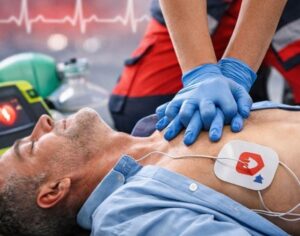
How to Perform CPR on an Adult: Step-by-Step Guide
How to perform CPR on an adult: call 911, push hard and fast 2 inches deep at 100 to 120 per minute, and use an AED. Step-by-step hands-only CPR guide.
Cardiologist Serving Katy, Sugar Land, Greater Houston
Cardiac catheterization with coronary angiography is a hospital-based procedure that uses a thin tube and contrast dye to take X-ray pictures of the heart’s arteries and measure pressures inside the heart. Evaluation and follow-up take place at our Katy and Sugar Land offices; the procedure itself is scheduled at an affiliated hospital.

Dr. Khalid reviews your symptoms, history and test results himself
Visits in Katy and Sugar Land
Catheter and device procedures at an affiliated hospital
Office follow-up on medicines and risk factors
During cardiac catheterization, a cardiologist guides a thin, flexible tube called a catheter through a blood vessel in the wrist or groin up to the heart. For coronary angiography, contrast dye is injected through the catheter while X-ray video shows how blood flows through the coronary arteries. This shows where arteries are narrowed or blocked and how severe the narrowing appears. Pressures inside the heart chambers can also be measured, which helps evaluate heart failure and some valve problems.
Because it is an invasive test, catheterization is usually recommended when symptoms or other tests strongly suggest a significant problem, or when the result is likely to change treatment. It is performed in a hospital catheterization laboratory, not in our office. At Advanced Cardiology, Dr. Khalid evaluates whether catheterization is appropriate, performs or coordinates the procedure at an affiliated hospital where appropriate, and follows up with you afterward. The office will explain where your procedure will be scheduled.
Catheterization is not usually the first test. Many people start with an EKG, an echocardiogram, a stress test, or CT angiography. These non-invasive tests carry less risk and often answer the question. Catheterization becomes the next step when those results suggest significant narrowing, when symptoms are severe or changing despite medication, or when the information is needed to plan treatment such as a stent or surgery.
One advantage of catheterization is that, if a suitable narrowing is found, angioplasty and stenting can sometimes be performed during the same procedure. Whether that is the right choice depends on the findings and is discussed with you beforehand.

Adnan Khalid, MD, Cardiologist
Adnan Khalid, MD, specializes in treating coronary artery disease, peripheral artery disease, heart failure, hypertension, arrhythmias, and hyperlipidemia. He has over 10 years of experience in the field of cardiovascular medicine.
Dr. Khalid graduated from his medical school among the top 10 out of 250 medical students in his class. He is fellowship trained in cardiovascular diseases, interventional cardiology, advanced heart failure, and transplant cardiology. He is focused on providing personalized and compassionate care. Dr. Khalid believes in spending time with his patients and listening to their needs and is committed to offering excellent care.
Dr. Khalid is an avid reader. He is eager to learn new things; He likes to work out and spend time with his family. When off from work, he likes to travel and spend time in nature along with family and friends. He is married with three children. Dr. Adnan Khalid is now seeing patients at our Katy and Sugar Land offices and welcomes new patients from across the greater Houston area.
American Board of Internal Medicine
Interventional Cardiology
Catheterization is often considered after an abnormal stress test or CT scan, or when symptoms suggest significant coronary artery disease. It gives direct pictures of the coronary arteries and pressure measurements inside the heart.
Risk factors alone are not a reason for catheterization in someone without symptoms or abnormal test results.
They can show:
They cannot show: everything about the artery wall. Angiography shows the open channel inside the artery, so plaque that has not narrowed the channel may not be visible. It also does not record heart rhythm over time and is not the best test for detailed valve structure, which an echocardiogram or TEE shows better.
A coronary calcium scan measures calcified plaque but not narrowing. CT angiography shows the arteries from outside the body using contrast and X-rays. Stress tests show the effect of narrowing on blood flow. Invasive angiography gives the most direct pictures and allows treatment in the same procedure, but it carries more risk.
Follow the specific instructions your care team and the hospital give you. You will usually be asked not to eat or drink for several hours beforehand. Blood thinners, diabetes medicines (including insulin and SGLT2 inhibitors), and some other drugs may need to be adjusted, but only as directed; do not stop any medication on your own. Tell the team about allergies, especially to contrast dye or iodine, kidney problems, and whether you might be pregnant. Blood tests are often done ahead of time. Arrange for someone to drive you home.
You lie on a table in the catheterization laboratory and usually receive medicine to help you relax while staying awake. The skin at the wrist or groin is numbed, and a small tube is placed in the artery. You may feel pressure but should not feel the catheter moving inside your body. Many people feel a brief warm flush when dye is injected. A diagnostic procedure often takes 30 to 60 minutes, longer if a stent is placed. Afterward, pressure or a closure device is used at the access site, and you are monitored for several hours; some patients stay overnight.
Catheterization is commonly performed, but it is invasive. Possible risks include bleeding or bruising at the access site, damage to the blood vessel, allergic reaction to contrast, kidney strain from contrast, irregular heart rhythms, and, rarely, heart attack, stroke, or the need for emergency surgery. Your care team reviews your individual risks with you before the procedure.
Recovery varies. Many people return to light activity within a day or two, with limits on lifting and on using the wrist or leg that was accessed. The care team usually discusses the main findings after the procedure, and Dr. Khalid reviews the results and next steps with you at follow-up. Call the care team for increasing swelling, bleeding, numbness, or color change at the access site, and call 911 for heavy bleeding, chest pain, or stroke symptoms.
Will I be asleep? Usually not. Most people receive medicine to relax and stay comfortable but remain awake enough to follow instructions.
Wrist or groin: which is used? Both are common. The choice depends on your anatomy, the planned procedure, and the physician’s judgment. The wrist approach often allows sitting up sooner.
Will I need a stent? Not necessarily. Many catheterizations show narrowings that are best treated with medication, and some show no significant narrowing at all.
Can I go home the same day? Many people go home the same day after a diagnostic procedure; others stay overnight, especially after a stent. The hospital team will tell you what to expect.
What should I bring to my follow-up visit? Bring your hospital discharge papers, an updated medication list, and any questions about activity, driving, or returning to work. If a stent was placed, bring the stent card you were given and do not stop any blood-thinning medicine unless your cardiologist tells you to.
Catheterization is scheduled at an affiliated hospital after an office evaluation, and the office will explain where and when. Call our office to ask about current availability for a consultation. If you have chest discomfort that lasts more than a few minutes or comes and goes, shortness of breath, a cold sweat, or stroke signs, call 911 rather than waiting for an appointment.
Most major insurance plans are accepted, and coverage is verified individually. Catheterization usually requires prior authorization, and hospital charges are billed separately from office visits. Our staff can help with the authorization process.

Catheterization results help guide treatment, together with your symptoms, other tests, and overall health. Options may include:
The number of narrowed arteries alone does not decide between a stent and bypass surgery. Location and pattern of disease, diabetes, heart function, and your preferences all matter, and the options are discussed with you.
Sources: NHLBI: Cardiac Catheterization · NHLBI: Coronary Heart Disease · NHLBI: Heart Tests · AHA: Warning Signs of a Heart Attack
Please print out your paperwork and bring it to your appointment at Advanced Cardiology. If your insurance requires authorization, please be sure to have that information sent to our office or bring it with you to your appointment, along with any medical records you may have. Please also make sure to bring your insurance cards, photo ID, and medication list.
Thank you, and we look forward to meeting you! Contact us today with any questions.
Most insurance plans accepted
(713) 258-6111
Katy & Sugar Land Cardiologist
# Cooperative & professional staff. Dr. Khalid is highly competent & experienced. Very kind & friendly too.
# He’s A Very Caring & Concerned Doctor. He Asks Important Questions, He Allows Me To Ask Questions & Fully Answers To My Satisfaction. He Diagnosis & Does Whatever It Takes To Fix My Health Issues. He’s A Wonderful Doctor…& Most Of All, I Trust Him & His Staff.
Read More…..
How to perform CPR on an adult: call 911, push hard and fast 2 inches deep at 100 to 120 per minute, and use an AED. Step-by-step hands-only CPR guide.
Cardiac failure and heart failure mean the same thing. Learn the types (HFrEF, HFpEF, left vs right), how it differs from cardiac arrest and how it is treated.

Reasons for shortness of breath include heart failure, coronary disease, asthma, COPD, anemia and anxiety. Learn the clues, when to worry and when to call 911.
When should you see a cardiologist? Learn the symptoms, risk factors and test results that call for a heart specialist, and what to expect at a first visit.
What doctor should you see for chest pain? Learn when to call 911, when to see a cardiologist and which tests to expect in Katy and Sugar Land, TX.
Short of breath walking upstairs? Learn what is normal, when it may signal heart disease or heart failure, the tests a cardiologist uses and when to call 911.
Katy & Sugar Land Cardiologist
Advanced Cardiology welcomes new patients at its offices in Katy and Sugar Land. Call our office or send an appointment request, and our staff will follow up.
Most major insurance plans accepted; coverage is verified individually.
For possible heart attack or stroke symptoms, call 911.