
Cardiac Clearance Before Surgery
Preoperative Cardiac Clearance in Katy & Sugar Land, TX
Surgeons and anesthesiologists ask for cardiac clearance when a patient's heart history, age, or risk factors could affect the safety of an operation. The purpose is not to find a reason to cancel surgery. It is to confirm that the heart can handle the stress of the procedure, identify any condition that should be treated first, and give the surgical team a clear plan for medications and monitoring. At Advanced Cardiology, Adnan Khalid, MD provides preoperative cardiac evaluations that are thorough, timely, and written in the form surgeons need.
Evaluations are scheduled promptly at the Katy and Sugar Land offices so surgery dates are not delayed.
Board-Certified Cardiologist • Katy & Sugar Land • New Patients Welcome

Understanding Clearance
What Is Preoperative Cardiac Clearance?
Anesthesia and surgery place real demands on the heart: fluid shifts, blood pressure changes, blood loss, pain, and the stress response all raise the heart's workload for hours to days. For most people that is uneventful. For patients with coronary disease, heart failure, valve disease, a rhythm problem, or several risk factors, the surgical team wants to know in advance how the heart is likely to respond and whether anything should be done first.
A preoperative cardiac evaluation, often called clearance or risk stratification, answers that. It estimates the risk of a cardiac complication around the time of surgery, based on the type of operation and the patient's condition, and determines whether any testing or treatment would lower that risk. In most cases the answer is that surgery can proceed with a few specific instructions. Occasionally the evaluation finds a problem, such as a significant valve narrowing or uncontrolled heart failure, that should be addressed before an elective operation.
The evaluation is also the time to decide what happens to cardiac medications: which to continue through surgery, which to hold, and, for patients on blood thinners or antiplatelet drugs after a stent, exactly how and when to pause them. Those instructions prevent more complications than any test.
Who Needs It
Who Needs Cardiac Clearance Before Surgery?
Your surgeon or anesthesiologist decides whether to request an evaluation, and the request is usually driven by one or more of the following:
- A history of heart attack, stent, bypass surgery, heart failure, cardiomyopathy, or valve disease
- A pacemaker or defibrillator
- Atrial fibrillation or another rhythm disorder, especially if you take a blood thinner
- Chest pain, shortness of breath, fainting, or reduced exercise tolerance that has not been evaluated
- A heart murmur that has never been imaged
- An abnormal EKG on the pre-surgical screening
- Diabetes, kidney disease, prior stroke, or peripheral artery disease
- Age over 65 with several risk factors, or an inability to climb a flight of stairs without stopping
- A higher-risk operation, such as vascular, major abdominal, thoracic, or orthopedic surgery, or a long procedure with significant expected blood loss
Patients on antiplatelet therapy after a recent stent need particularly careful planning, because stopping those medications too early carries a real risk of stent thrombosis.

What Is Assessed
What the Evaluation Looks At
Surgical cardiac risk depends on both the patient and the procedure. The evaluation weighs each of these.
Type of Surgery
Cataract or skin surgery carries minimal cardiac risk; vascular, major abdominal, and long orthopedic operations carry more. The type of operation sets the baseline.
Functional Capacity
Whether you can climb two flights of stairs or walk briskly without symptoms is one of the most reliable predictors and often makes testing unnecessary.
Active Cardiac Conditions
Unstable chest pain, decompensated heart failure, a significant arrhythmia, or severe valve disease should be treated before elective surgery.
Clinical Risk Factors
Coronary disease, heart failure, diabetes on insulin, kidney disease, and prior stroke each add to the risk score used to guide decisions.
Medication Management
Blood thinners, antiplatelet drugs, beta blockers, and diabetes medications each need a specific hold-or-continue plan around the operation.
Implanted Devices
Pacemakers and defibrillators may need a settings check or temporary reprogramming for surgery, and the surgical team needs the device details.

Meet Your Cardiologist
Preoperative Evaluation With Adnan Khalid, MD
Adnan Khalid, MD is a board-certified cardiologist with fellowship training in cardiovascular disease, interventional cardiology, and advanced heart failure and transplant cardiology. Preoperative evaluation draws on all three: judging whether a coronary lesion matters for surgery, managing antiplatelet therapy after a stent, and stabilizing heart failure before an operation are everyday questions in those fields.
Dr. Khalid follows current guidelines, which favor a careful history and examination over reflexive testing. Most patients are cleared at the first visit with a written note and specific medication instructions. When testing is needed, it is arranged quickly, and when a condition should be treated first, he communicates directly with the surgeon so the timeline is clear. His notes are written to answer the questions surgeons and anesthesiologists actually ask.
The Evaluation
How a Preoperative Cardiac Evaluation Works
The evaluation follows a stepwise approach recommended by cardiology and anesthesia guidelines, and for most patients it stops early.
History
Dr. Khalid reviews your cardiac history, prior procedures, and current symptoms, with particular attention to chest discomfort, breathlessness, fainting, and how much activity you can do. He confirms the planned operation, its urgency, and what your surgeon has asked.
Examination and EKG
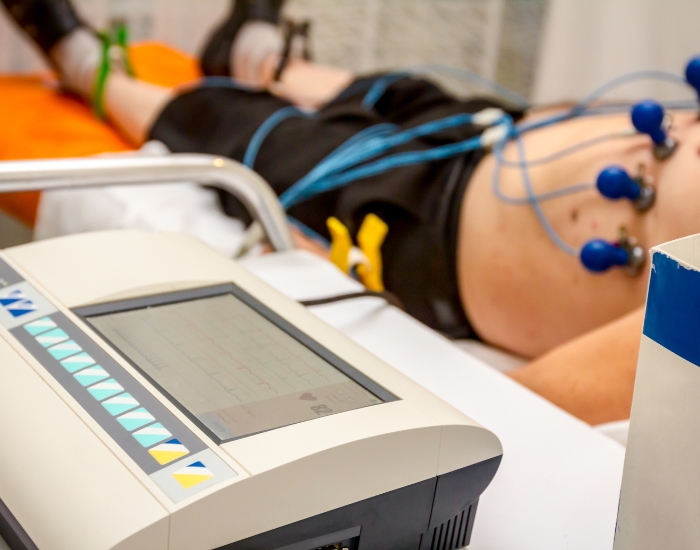
The exam includes blood pressure, heart rhythm, murmurs, lung sounds, and signs of fluid retention. An EKG is obtained and compared with any prior tracing.
Risk Estimation
Your clinical risk factors and the type of surgery are combined into a risk estimate. Patients at low risk, or who can comfortably climb two flights of stairs, generally need no further testing and are cleared at this point.
Testing Only When It Changes Management
For higher-risk patients with poor or unknown functional capacity, testing is considered only if the result would change the surgical plan. An echocardiogram is used for a murmur or suspected heart failure; stress testing for possible coronary disease. Routine testing in low-risk patients is avoided because it delays surgery without improving safety.
Testing
Testing That May Be Part of Cardiac Clearance
Most patients need only an EKG. The other tests are reserved for specific questions.
Electrocardiogram (EKG)
Obtained for nearly all patients with cardiac risk factors. Provides a baseline for comparison after surgery and screens for silent problems.
Echocardiogram
For a murmur that has never been imaged, known valve disease, suspected heart failure, or breathlessness of unclear cause. Performed in the office.
Stress Testing
For higher-risk patients with poor or unknown exercise capacity before major surgery, when the result would change the plan. Coordinated at an outside facility.
Blood Tests
BNP, kidney function, blood count, and glucose help gauge heart strain and surgical risk and are often already ordered by the surgical team.
Device Check
Patients with a pacemaker or defibrillator have the device interrogated so the surgical team knows its settings and dependence.
Coronary Evaluation
Rarely needed before non-cardiac surgery, and only when a stress test or symptoms suggest a blockage that would be treated regardless of the planned operation.
The Outcome
What Cardiac Clearance Provides
The product of the evaluation is a written note to your surgical team. It states the estimated cardiac risk for the planned operation and, more importantly, gives specific instructions.
Medication plan. Which cardiac medications to take on the morning of surgery, which to hold and for how long, and when to restart them. Beta blockers and statins are usually continued. Blood thinners and antiplatelet drugs are managed according to the reason they were prescribed and the bleeding risk of the operation, and patients with a recent stent receive a specific plan agreed with the surgeon.
Conditions to optimize first. If blood pressure is uncontrolled, heart failure is not stable, or a rhythm needs better control, that is addressed before an elective operation, usually over days to a few weeks.
Conditions that change the plan. Occasionally the evaluation finds severe valve disease, unstable coronary disease, or a significant arrhythmia that should be treated before surgery. Dr. Khalid discusses this directly with the surgeon so the sequence and timing are clear.
Perioperative recommendations. Monitoring, device management, and what to watch for after surgery. A follow-up visit is arranged if a new condition was found.
Your Visit
What to Expect and What to Bring
Tell the scheduling team the surgery date so the visit can be placed appropriately, ideally two to four weeks beforehand. Bring the surgeon's request or clearance form, the name of the procedure and the surgeon, and any pre-surgical EKG or lab results already done. Bring prior cardiac records if you have been seen elsewhere: echocardiogram and stress test reports, catheterization results, and stent or device details.
Bring a complete medication list with doses, including blood thinners, aspirin, diabetes medications, and supplements. Be ready to describe how much activity you can do without symptoms.
The visit includes the history, an examination, and an EKG. Most patients are cleared at this visit and the note is sent to the surgeon the same day. If testing is needed, it is scheduled promptly and the note follows the result.
Katy Cardiology Care
Cardiac Clearance Before Surgery in Katy, TX
Surgeons across Katy, Cinco Ranch, Fulshear, and West Houston refer patients to the Grand Parkway office for preoperative cardiac evaluation before orthopedic, general, urologic, gynecologic, and other operations. Patients with a prior stent, a pacemaker, atrial fibrillation on a blood thinner, or heart failure make up a large share of these visits.
EKG and echocardiography are performed on site, device checks are available, and clearance notes are sent to the surgeon the same day in most cases. Mention your surgery date when scheduling so the visit is placed in time. For other services at this location, see cardiology care in Katy.
Advanced Cardiology – Katy
410 W Grand Pkwy S Ste 4D
Katy, TX 77494
Phone: (713) 258-6111
Advanced Cardiology – Sugar Land
7102 Tarrington Ave Suite 505
Sugar Land, TX 77479
Phone: (713) 258-6111
Sugar Land Cardiology Care
Cardiac Clearance Before Surgery in Sugar Land, TX
At the Tarrington Avenue office, Dr. Khalid provides preoperative evaluations for patients from Sugar Land, Richmond, Rosenberg, Missouri City, and Stafford referred by surgeons and surgical centers across the area. Many have diabetes, kidney disease, or a prior cardiac event, and a growing number are on newer blood thinners that need a precise hold schedule.
EKG, echocardiography, and device checks are available on site, and the clearance note is communicated to the surgical team promptly. Learn more about cardiology care in Sugar Land.
Serving Greater Houston
Serving Patients Across Greater Houston
Patients come to the Katy and Sugar Land offices from across Greater Houston, including Cypress, Richmond, Rosenberg, Fulshear, and West Houston, for cardiac clearance before surgery. Both offices offer the same physician and the same approach; choose the one that is easier to reach, and the scheduling team can help if you are unsure.
Patient-Centered Cardiology
Why Surgeons and Patients Choose Advanced Cardiology
Board-Certified Cardiology Expertise
Care led by Adnan Khalid, MD, with fellowship training in cardiovascular disease, interventional cardiology, and advanced heart failure.
Timely Appointments
Preoperative visits are prioritized so surgery dates are not pushed back waiting for clearance.
No Unnecessary Testing
Testing is ordered only when it would change the surgical plan, in line with current guidelines.
Actionable Clearance Notes
Clearance notes give surgeons and anesthesiologists specific medication and monitoring instructions, not just a signature.
Two Convenient Locations
Offices in Katy and Sugar Land serving surrounding Greater Houston communities.
New Patients Welcome
New patients are welcome. Most major insurance plans are accepted, subject to eligibility and coverage verification.
Common Questions
Frequently Asked Questions About Cardiac Clearance
What is cardiac clearance for surgery?
It is a cardiologist's evaluation of how safely your heart can tolerate a planned operation. It estimates the risk of a cardiac complication, identifies anything that should be treated first, and gives the surgical team specific instructions on medications and monitoring. For most patients it confirms that surgery can proceed.
Who needs cardiac clearance before surgery?
Patients with a history of heart attack, stent, bypass, heart failure, valve disease, arrhythmia, or a pacemaker or defibrillator; those with unexplained chest pain, breathlessness, or an abnormal EKG; and older patients with several risk factors facing major surgery. Your surgeon or anesthesiologist decides whether to request it.
How long does cardiac clearance take?
Most patients are cleared at a single visit with a history, examination, and EKG, and the note is sent to the surgeon the same day. If an echocardiogram or stress test is needed, clearance follows the result, usually within one to two weeks. Schedule the evaluation two to four weeks before surgery when possible.
Will I need a stress test before surgery?
Not usually. Current guidelines recommend stress testing only for higher-risk patients with poor or unknown exercise capacity before major surgery, and only when the result would change the plan. If you can climb two flights of stairs without symptoms, a stress test is rarely needed.
Should I stop my blood thinner before surgery?
It depends on why you take it and the bleeding risk of the operation. Blood thinners are usually held for a specific number of days before surgery and restarted afterward; antiplatelet drugs after a recent stent require a careful plan agreed between your cardiologist and surgeon. Never stop these medications on your own.
Can cardiac clearance delay my surgery?
Occasionally, yes. If the evaluation finds an active cardiac condition such as unstable angina, decompensated heart failure, severe valve disease, or an uncontrolled arrhythmia, treating it first makes surgery safer. Your cardiologist and surgeon coordinate the timing directly. In most cases surgery is not delayed at all.
Which heart medications do I take on the day of surgery?
Beta blockers and statins are almost always continued, including on the morning of surgery. Blood pressure medications, diuretics, diabetes medications, and blood thinners each have specific instructions that depend on the operation. You will receive a written list of what to take and what to hold.
Do I need to bring my surgeon's paperwork?
Yes. Bring the surgeon's request or clearance form, the name and date of the procedure, prior cardiac test reports, stent or device details, and a complete medication list with doses. Having these on hand allows most patients to be cleared at the first visit.
Keep Reading
Related Heart Health Resources
- What Are Signs of Blocked Arteries in the Heart?
- What Are Early Signs of Heart Failure?
- Reasons for Shortness of Breath: Heart-Related Causes
- Why Is My Blood Pressure Suddenly High?
Related services: Abnormal EKG • Heart Murmur Evaluation • Echocardiography • Pacemaker & ICD Checks • Atrial Fibrillation • Heart Disease Risk Assessment
Medical Review: Adnan Khalid, MD
Cardiology Appointments
Take the Next Step
If your surgeon has asked for cardiac clearance, schedule the evaluation early so your operation stays on track. Adnan Khalid, MD provides prompt preoperative cardiac evaluations at Advanced Cardiology's Katy and Sugar Land offices.
Katy: 410 W Grand Pkwy S Ste 4D, Katy, TX 77494
Sugar Land: 7102 Tarrington Ave Suite 505, Sugar Land, TX 77479
If you develop chest pain, severe shortness of breath, or fainting before your surgery, call 911 and inform your surgeon.