
Why Does My Back Hurt With Chest Pain?
Back pain with chest pain may be a muscle strain or reflux, but also a heart attack or aortic dissection. Learn the causes, warning signs and when to call 911.
Cardiologist Serving Katy, Sugar Land, Greater Houston
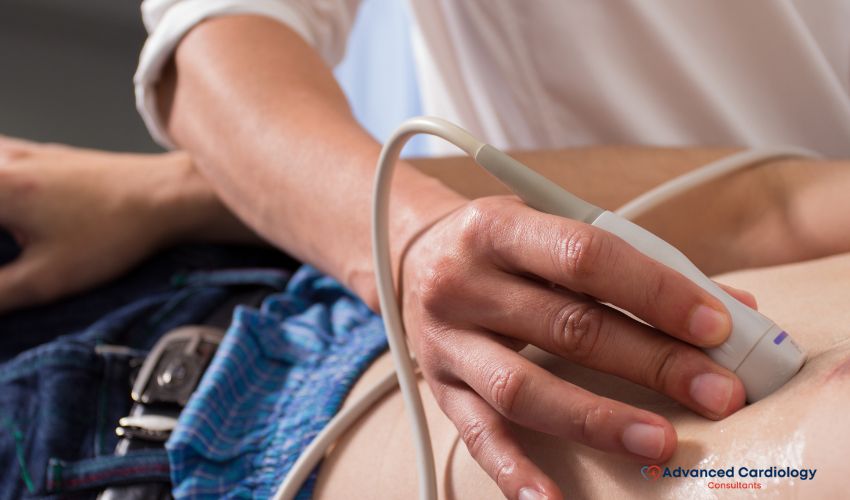
A stress echocardiogram compares ultrasound pictures of your heart at rest and right after exercise or a heart-stimulating medicine. It can help evaluate chest discomfort, shortness of breath with exertion, or an unclear result on another test. At Advanced Cardiology, stress echo is performed or arranged by our office, and Adnan Khalid, MD reviews the results.
Dr. Khalid reviews your symptoms, history and test results himself
Visits in Katy and Sugar Land
Catheter and device procedures at an affiliated hospital
Office follow-up on medicines and risk factors
A stress echo combines an echocardiogram (an ultrasound of the heart) with physical stress on a treadmill or, for people who cannot exercise, a medicine such as dobutamine that makes the heart beat faster and harder. Images taken at rest are compared with images taken at peak stress. Heart muscle that gets enough blood moves more vigorously under stress; an area that does not may move less, which can point to a narrowed coronary artery.
The test uses ultrasound, so there is no radiation. It is often chosen when a resting EKG or echo does not explain your symptoms, or when an exercise EKG alone would be hard to interpret. It is performed or arranged by our office for patients of our Katy and Sugar Land locations, and Dr. Khalid reviews the findings together with your symptoms and history.

Adnan Khalid, MD, Cardiologist
Adnan Khalid, MD, specializes in treating coronary artery disease, peripheral artery disease, heart failure, hypertension, arrhythmias, and hyperlipidemia. He has over 10 years of experience in the field of cardiovascular medicine.
Dr. Khalid graduated from his medical school among the top 10 out of 250 medical students in his class. He is fellowship trained in cardiovascular diseases, interventional cardiology, advanced heart failure, and transplant cardiology. He is focused on providing personalized and compassionate care. Dr. Khalid believes in spending time with his patients and listening to their needs and is committed to offering excellent care.
Dr. Khalid is an avid reader. He is eager to learn new things; He likes to work out and spend time with his family. When off from work, he likes to travel and spend time in nature along with family and friends. He is married with three children. Dr. Adnan Khalid is now seeing patients at our Katy and Sugar Land offices and welcomes new patients from across the greater Houston area.
American Board of Internal Medicine
Interventional Cardiology
When an EKG or resting echo does not provide enough information, a stress echo shows how the heart responds to increased demand.
Why it matters: It may be a sign of coronary artery disease.
How a stress echo helps: It looks for areas of heart muscle that move less under stress, which suggests reduced blood flow. See chest pain evaluation.
Why it matters: It can come from the heart, including valve disease or a stiff or weakened heart muscle, or from other causes.
How a stress echo helps: It shows how the heart pumps under stress and, in some cases, how a valve behaves with exercise.
Why it matters: An exercise EKG can be falsely abnormal or hard to read.
How a stress echo helps: The added images can clarify whether reduced blood flow is likely and whether further testing such as angiography is worth considering.
Why it matters: New or worsening symptoms may need reassessment.
How a stress echo helps: It shows exercise tolerance and whether symptoms or wall-motion changes appear under stress.
Why it matters: Most people do not need a stress test before surgery.
How a stress echo helps: For selected patients with poor or unknown exercise capacity facing higher-risk surgery, and when the result would change care, it can help guide planning. Learn more about preoperative cardiac evaluation.
It can show:
It cannot show: the coronary arteries themselves, or the exact location and severity of a narrowing. Image quality can be limited by body build or lung disease, and a mild narrowing may not cause a visible change. Like all stress tests, results can occasionally be falsely abnormal or falsely reassuring.
An exercise stress test uses the EKG, blood pressure, and symptoms with no imaging. A stress echo adds ultrasound images and uses no radiation. A nuclear stress test uses a radioactive tracer to map blood flow. Not every stress test uses a radiotracer. Dr. Khalid recommends the test most likely to answer your specific question.

Follow the specific instructions your care team gives you. These often include not eating a heavy meal for a few hours beforehand and avoiding caffeine and tobacco for a period before the test. Some heart medicines, such as beta-blockers, can affect the results, but do not stop or change any medication on your own; Dr. Khalid or the office will tell you what to take. Wear comfortable clothing and walking shoes, and bring your medication list.
Electrodes are placed on your chest and a blood pressure cuff on your arm. A sonographer takes resting ultrasound images while you lie on your left side. You then walk on a treadmill with the speed and incline increasing every few minutes, and when you reach your peak, you lie back down quickly so the stress images can be captured within about a minute. If you cannot exercise, a medicine is given through an IV in gradually increasing doses while images are taken. Some patients receive an ultrasound contrast agent to make the images clearer. The appointment usually takes about an hour.
You may feel tired, short of breath, or sore in the legs. Medication stress can cause palpitations, flushing, or nausea that usually fade after the medicine stops. Serious problems such as dangerous rhythms or a heart attack are uncommon, and the test is supervised so it can be stopped and treated promptly. Tell the staff right away about chest pain, lightheadedness, or unusual shortness of breath.
Dr. Khalid reviews the rest and stress images and explains the findings at a follow-up visit or by another method the office arranges; timing varies. If a result needs prompt attention, the office will contact you.
A stress echo needs a trained sonographer to capture the images, staff to monitor your EKG and blood pressure, and a physician to supervise and interpret the study. Our office will tell you where your test will take place. Dr. Khalid reviews the findings in the context of your symptoms, your other test results, and any prior studies, so it helps to bring copies of earlier echocardiograms or stress tests from other providers.
A stress test may be postponed or a different test chosen if you have symptoms that are getting worse at rest, very high blood pressure on the day of the test, certain severe valve problems, or an uncontrolled rhythm problem. Tell the office about recent hospital stays or new symptoms before your appointment.
If you have unexplained chest discomfort, breathlessness, or fatigue with activity, an evaluation with Adnan Khalid, MD can help determine whether a stress echo or another test is right for you. Call our office to ask about current availability at the Katy and Sugar Land locations.
Call 911 instead of waiting for a test if you have chest discomfort lasting more than a few minutes or that comes and goes, discomfort in the arm, back, neck, jaw, or stomach, shortness of breath, a cold sweat, nausea, or lightheadedness, or stroke signs such as face drooping, arm weakness, or speech difficulty, even if they go away.
Most major insurance plans are accepted, and coverage is verified individually. Some plans require prior authorization for stress echocardiography. Please call our office or check with your insurance provider for specific coverage details.
A normal stress echo with good exercise capacity is reassuring, although it does not completely rule out coronary artery disease. Based on your results and overall situation, Dr. Khalid may recommend:
If you have already had an abnormal result elsewhere, see abnormal stress test evaluation.
Does a stress echo involve radiation? No. It uses ultrasound. If a contrast agent is used, it is not radioactive.
What if I cannot walk on a treadmill? A medication can increase your heart rate instead, and the images are compared the same way.
Sources: NHLBI: Heart Tests · NHLBI: Coronary Heart Disease · ACC: 2024 AHA/ACC Perioperative Guideline · AHA: Warning Signs of a Heart Attack
Please print out your paperwork and bring it to your appointment at Advanced Cardiology. If your insurance requires authorization, please be sure to have that information sent to our office or bring it with you to your appointment, along with any medical records you may have. Please also make sure to bring your insurance cards, photo ID, and medication list.
Thank you, and we look forward to meeting you! Contact us today with any questions.
Most insurance plans accepted
(713) 258-6111
Katy & Sugar Land Cardiologist
# Cooperative & professional staff. Dr. Khalid is highly competent & experienced. Very kind & friendly too.
# He’s A Very Caring & Concerned Doctor. He Asks Important Questions, He Allows Me To Ask Questions & Fully Answers To My Satisfaction. He Diagnosis & Does Whatever It Takes To Fix My Health Issues. He’s A Wonderful Doctor…& Most Of All, I Trust Him & His Staff.
Read More…..
Back pain with chest pain may be a muscle strain or reflux, but also a heart attack or aortic dissection. Learn the causes, warning signs and when to call 911.

Jaw pain with chest pain can warn of a heart attack or angina, especially in women. Learn how it differs from dental or TMJ pain and when to call 911.
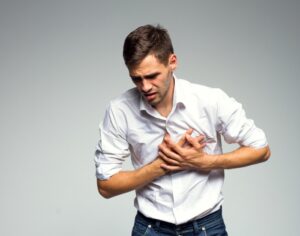
Feeling weak and shaky with chest pain can be low blood sugar, anxiety or dehydration, but also a heart attack or rhythm problem. Know when to call 911.
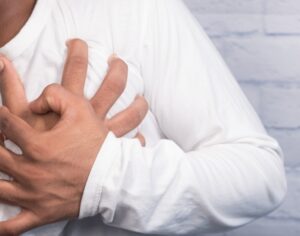
Should you go to the ER for chest pain? Learn which symptoms need 911, ER vs urgent care, what happens in the ER, and when to follow up with a cardiologist.

Severe abdominal pain can feel frightening, exhausting, and overwhelming, especially when symptoms suddenly worsen or spread throughout the abdomen. Many people initially dismiss stomach pain as indigestion, food poisoning, gas, or minor illness, only to later discover they are experiencing appendicitis or even a ruptured appendix. A burst appendix, also called a ruptured appendix, is […]

Severe headache and nausea is often migraine, but sudden pain, very high blood pressure, weakness or confusion need the ER. Learn red flags and where to go.
Katy & Sugar Land Cardiologist
Advanced Cardiology welcomes new patients at its offices in Katy and Sugar Land. Call our office or send an appointment request, and our staff will follow up.
Most major insurance plans accepted; coverage is verified individually.
For possible heart attack or stroke symptoms, call 911.